Qualcomm:5G Leadership Comes from Long-term Investment
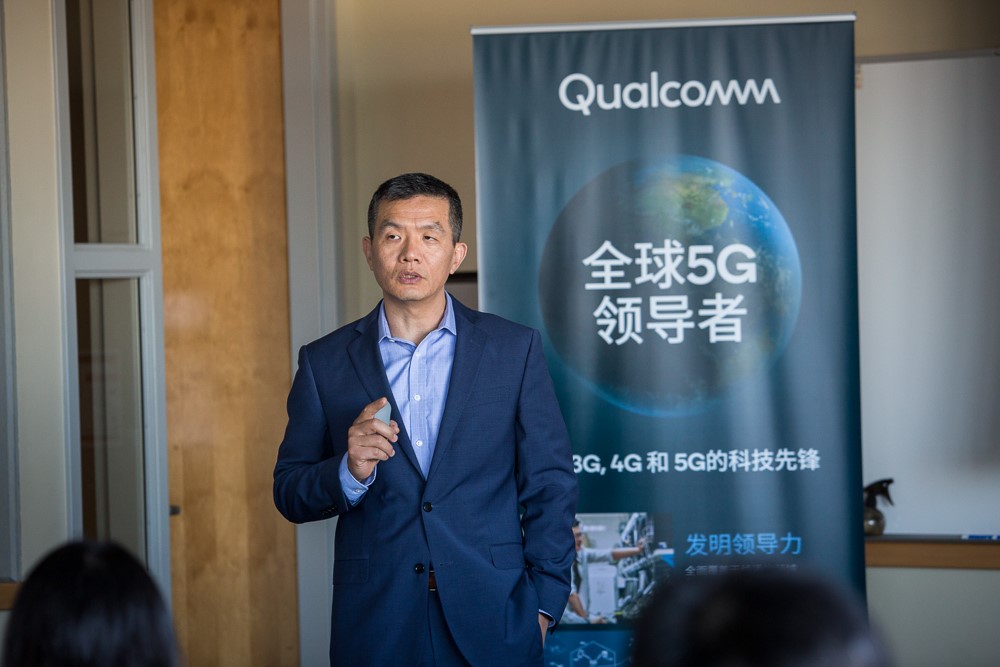
The 5G Standard Essential Patents (SEP) ranking that IPlytics, a German patent data company, periodically releases sparked a discussion on the quantity, quality and value of patents in the industry. When talking about 5G fundamental R&D and patent value recently, Liren Chen, Senior Vice President of Engineering and Legal Counsel at Qualcomm Technology Licensing (QTL), said Qualcomm has made a long-term massive R&D investment in 5G fundamental research. Quantity cannot fully reflect patent value, which needs to be measured by the market value.
Liren Chen first introduced Qualcomm’s investment in fundamental research and history in 5G R&D. Since the company’s establishment in 1985, Qualcomm’s aims to solve system problems in wireless digital communications by conducting the most fundamental technological R&D. From its establishment to the third fiscal quarter of 2019, Qualcomm has invested over $58 billion in R&D. Qualcomm invests amazingly over 20% of its revenue in R&D. The percentages at many companies, including tech firms, are often less than 10% with few over 10% and very rare over 20%.
Liren Chen pointed out that you have to be visionary in fundamental research and stay 5-10 years ahead in the industry. A longer-term leadership means that you are more likely going deep into the most fundamental R&D. Qualcomm started 2G research early in 1988 with standardization and commercialization in 1995; 3G research in 1997 with standardization in 2000; and 4G research in 1998 with standardization and commercialization in 2009. It is the same with 5G. Qualcomm started 5G fundamental research early in more than 10 years ago. The record indicates that the R&D, standardization and commercialization of different generations are overlapping. What’s more, each generation is built on the previous generation. In many cases, many 3G and 4G technologies can be extended to 5G. From the most fundamental physical layer, 5G and 4G share the same waveform of OFDM and many other communications like channel setup, MIMO and carrier aggregation. According to Qualcomm’s internal statistics, Qualcomm’s many 4G patented technologies can be used in 5G. Many 4G technologies are relevant and extensible to 5G. After all, Qualcomm’s 5G leadership is a result of its accumulation in technological R&D.
Liren Chen stressed that Qualcomm’s commitment to solve system level problems is also reflected by the broad range of technologies that Qualcomm is researching. Qualcomm’s R&D areas include charging, positioning, security, photography, display, video, audio, computer vision, fingerprint sensing, cloud computing, machine learning, sensor aggregation, Wi-Fi, Bluetooth, base station, automotive, smart city, semiconductor etc. Taking photography as an example, photo quality relies more on technological system than solely on the camera module. First, the camera quality must be good. Then, photos taken will be processed on ISP and other software and hardware. What follows is to send the photo through Wi-Fi or cellular to other phones, which reproduces and displays the photo. Therefore, there are also many display problems to solve, including tuning and color fidelity. High quality photos require the best of each part, ensuring that a photo taken on one phone is displayed rightly on another. The whole process is a system-level problem. Qualcomm has rich experiences in system-level solutions.
Liren Chen also introduced Qualcomm’s business model. Qualcomm has two major businesses: Qualcomm Technology Licensing (QTL) and Qualcomm CDMA Technologies (QCT), the latter is for chipset business. As a tech firm solving systematic problems, Qualcomm Technology Licensing shares Qualcomm’s patented technologies to the entire ecosystem. Up to now, Qualcomm has signed over 300 licensing agreements worldwide and licensed over 11 billion mobile devices, nearly two times of global population (less than 7 billion). QTL’s revenue provides support for R&D efforts. A big part of Qualcomm’s $58 billion R&D spending up to now comes from QTL.
While sharing Qualcomm’s inventions and innovations, QTL also greatly supports the development of the entire ecosystem. Under Qualcomm’s support, Chinese OEMs have achieved a great success. Qualcomm’s cooperation with Chinese carriers is also fruitful. Qualcomm has dedicated teams to provide end-to-end supports carriers’ network deployment and optimized engineering. In addition, the industry chain that Qualcomm supports goes beyond OEMs and wireless carriers. Qualcomm has built long-term relationships with SMIC (Semiconductor Manufacturing International Corporation) and cooperated with partners from different industries like mobile communications and IoT. For example, Qualcomm, Leadcore Technology and Wise Road Capital established the JLQ Technology. Qualcomm helps Tencent Games to achieve more efficient and lower-latency experiences. In addition, Qualcomm always supports China’s innovation-driven development strategy. For example, Qualcomm established R&D and innovation center in China, launched joint R&D programs with universities, and set up a $150M VC fund in China.
Liren Chen said it doesn’t make much sense to measure patent value by quantity. Patent value should be measured by the market value.
Firstly, every patent is different, and any patent requires novelty, creativity and enablement. Analysis by experts in economics, law and intellectual property shows that the value of each patent is quite different. Taking the three Qualcomm patents infringed by Apple as an example, the jury decides that Apple must pay $1.41 royalty for each phone. Considering that Apple sells 200 million phones each year, you can imagine the value of these three patents. However, some patents are abandoned several years later since their values are too low. Therefore, the quality of a patent is a more important factor.
Secondly, the accuracy of SEP disclosure data still needs to be verified. The standard body’s disclosure of SEPs relies mostly on conscientiousness. If a company considers a patent as a standard essential one, it can disclose the patent. No third-party or legal process is in place to verify it.
Lastly, how the value of a patent is reflected? The value of a patent is determined by the market, which is easy to understand. Take the phone as example. Why some phones sell at $800, some at $300 and some at $1000? It’s because buyers and sellers reach a consensus on the phones’ value in the market. Qualcomm cannot determine the value of its patents on its own. The value is reflected through negotiations with over 300 licensing agreements. The value of Qualcomm’s patents is repeatedly verified in the market. Many licensees of Qualcomm’s patents are big companies, which proves the value of Qualcomm’s patent portfolio.
Qualcomm announced 5G patent licensing framework in November 2017. Qualcomm Executive Vice President and QTL President Alex Rogers said Qualcomm’s 5G technology licensing business is successful and over 35 5G licensing agreements have been signed worldwide.
By Liu Qi-cheng, Editor in Chief of Communications World Weekly.