中國的抗疫援助不是為了爭當全球霸主-周波
【文/周波,譯/武一琪】
在這次抗擊新冠疫情中,中國的表現可不像是一個發展中國家。據報道,目前中國已經向140多個國家和國際組織提供了各種醫療援助,並向12個國家派遣了共計14支專業醫療團隊。中國駐美大使崔天凱表示,截止到4月29日,中國向美國提供的口罩已經達到人均14只。
由於沒人知道疫情何時結束,所以這樣的援助一定還會繼續,因此北京的形象將進一步提高。
但別搞錯了:這並不意味着中國想要爭奪全球霸主。目前各種説法甚囂塵上,但恰恰相反,在西方國家忙於控制自己國內疫情之際,中國既沒有擺出“全球救世主”的樣子,也沒有把自己描繪成所謂的“新興超級大國”。中國表示自己所做的一切不過是在回饋國際社會對中國疫情爆發時提供的援助。
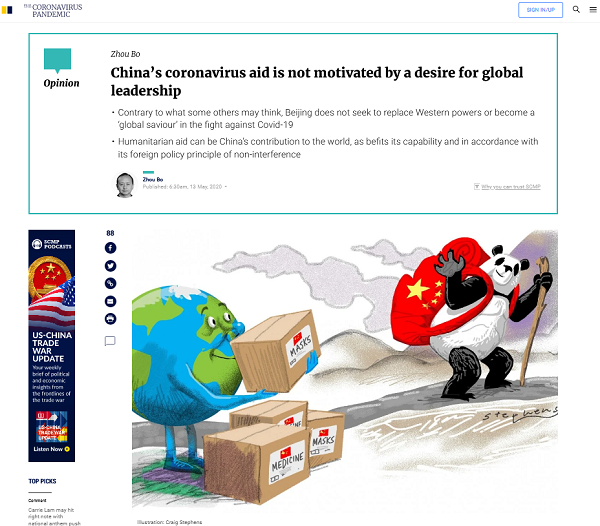
《南華早報》5月13日刊登周波文章《中國的抗疫援助不是為了爭當全球霸主》
首先,中國根本沒有爭奪全球霸主的野心。中國真正的雄心已經載入憲法,即實現“中華民族偉大復興”。這一漫漫征程長達30年之久,一直要到本世紀中期才能實現,其中每一個發展階段都有清晰的目標。最能説明中國政府決心的例子莫過於疫情肆虐也沒有削弱中國政府確保今年年底前消除絕對貧困的決心。
此外,中國的影響力已經無處不在。如今,在西方定製的國際制度和機構裏,中國似乎比美國更加遊刃有餘。當美國接連退出國際條約和機構之際,中國反而參與更深。
目前,在15個聯合國專屬機構中,中國人領導了4個涉及經濟活動的機構,即糧農組織、國際電信聯盟、聯合國工業發展組織和國際民用航空組織。
對中國“領導”角色的錯誤假設,部分原因是人在危機中本能地希望有人出面牽頭。2008年金融危機後,大國齊心協力恢復全球經濟,併為此召開了20國集團(G20)首屆領導人峯會,但這次卻悄無聲息。
聯合國秘書長安東尼奧•古特雷斯本月抱怨,在抗疫過程中全世界缺乏領導者。唐納德•特朗普似乎是第一位既沒有意願也沒有能力領導的美國總統。無需贅言,他宣佈停止為世界衞生組織提供資金援助引起世界一片譁然。
中國幫助世界其他國家的最好辦法並不是所謂“領導”,而是作為一個負責任的大國提供公共產品。問題是:中國能提供多少?由於人均國內生產總值低於發達國家和地區發展差距較大,中國政府堅持認為中國仍然是一個發展中國家。
但許多西方國家認為,中國已經是世界第二大經濟體,是世界上最大的工業製造國,擁有世界上最大的外匯儲備,是奢侈品消費量最高的國家,所以不可能是一個發展中國家。2019年,中國人均國內生產總值已經達到了10276美元,與世界銀行定義的“高收入國家”的12376美元相差並不遙遠。
兩種説法都不無道理。但無論中國地位究竟如何,中國政府多次表示將在力所能及的情況下向世界提供援助。近年來,中國的對外援助的確已經大幅增加。
2019年,中國超過日本成為聯合國第二大會費國。在特朗普撤回美國對世衞組織的資助後,中國宣佈將在此前提供的2000萬美元基礎上,再提供3000萬美元資助世衞組織的抗疫工作。
中國能提供的最好的公共物品是人道主義援助。這種支持是最沒有爭議的,而且更重要的是,因為中國的外交政策核心是不干涉內政,所以這幾乎可以説是為中國量身定做的。中國既沒有興趣取代美國成為“世界警察”,也沒有打算將美國趕出印度—太平洋地區。
值得一提的是,無論是維和、打擊海盜還是救災行動,中國在海外的軍事行動始終是人道主義性質的。例如,解放軍海軍的“和平方舟”號醫療船在過去的10年內為43個國家和地區的23萬多人提供了醫療服務。
中國提供人道主義援助確有優勢。作為“世界工廠”,中國的工業製造能力無與倫比。在冠狀病毒爆發之前,很少有中國人——包括我自己在內——意識到全世界居然在防護口罩等最基本的醫療用品方面如此依賴中國。
不難想象,富國今後將盡最大努力提高應對下一次病毒來襲的準備,但是窮國呢?這個需求是巨大的。《紐約時報》報道南蘇丹有5名副總統,卻只有4台呼吸機,有10個非洲國家連一台呼吸機都沒有。
不斷攀升的死亡率警示我們,微不可見的病毒可能遠比金融危機和大國競爭更加致命。它促使我們重新思考生活中究竟什麼對個人、家庭和社會最重要。
這次疫情不會是最後一次。如果中國的援助表明,下一場災難發生時,它能以這樣的力度再次參與,這對全世界而言,可謂至暗時刻的最好消息。
(“中國論壇”武一琪譯自《南華早報》,翻頁閲讀英文原文)
China’s coronavirus aid is not motivated by a desire for global leadership
In fighting the novel coronavirus, China looks like anything but a developing country. It has reportedly provided all kinds of medical supplies to over 140 countries and international organisations and sent 14 medical expert teams to 12 countries. According to Cui Tiankai, the Chinese ambassador to the United States, by April 29, China had provided 14 masks for every American on average.
Since no one knows when the pandemic might end, such assistance is poised to continue. As a result, Beijing’s visibility will only rise.
But make no mistake: this is not a sign of China wresting control of global leadership. Contrary to various allegations, China has not cast itself as a “global saviour” nor portrayed itself as an emerging superpower at a time that countries in the West are struggling to control domestic Covid-19 outbreaks. China has said it was only paying back the support it received when it was hit hard by the virus.
China does not harbour ambitions of global leadership in the first place. Its real ambition, as stated in its constitution, is to realise the “great rejuvenation of the Chinese nation”. China has pledged a 30-year long march to achieve this by mid-century, with clearly defined goals at different stages.
The most telling example of its resolve is that even the pandemic has not dented the government’s commitment to eliminate extreme poverty by the end of this year.
Besides, Beijing’s influence is already ubiquitous. Today, it appears more comfortable than Washington with the international regimes and institutions that are designed by the West. While Americans have withdrawn from international treaties and institutions one after another, the Chinese have stepped in.
Chinese nationals now head four of the 15 specialised United Nations agencies that deal with economic activity, namely the Food and Agriculture Organisation, the International Telecommunications Union, the UN Industrial Development Organisation, and the International Civil Aviation Organisation.
The incorrect assumption about China’s “leadership” role has been made partly because of the natural instinct to look for leadership in a crisis. In 2008, major powers worked together to restore the global economy in the wake of the financial crisis, convening the inaugural G20 leaders’ summit for this purpose. Not this time.
UN Secretary General Antonio Guterres fretted this month that there was a lack of leadership in the fight against Covid-19. Donald Trump appears to be the first American president who has neither the wish nor the ability to lead. Needless to say, his decision to halt funding for the World Health Organisation has sparked a global outcry.
The best way China can help the rest of the world is not to “lead”, but to provide public goods as a responsible power. The question is: how much can China provide? Citing its lower per capita GDP than that of developed nations and substantial regional differences in development, the Chinese government maintains that China is still a developing country.
But many in the West argue that the world’s second-largest economy, top manufacturer, holder of the world’s largest foreign exchange reserves and the biggest buyer of luxury goods cannot be a developing country. In 2019, China’s per capita GDP reached US$10,276, not that far from the US$12,376 of a “high-income economy” as defined by the World Bank.
There is a grain of truth in both statements. Whatever its status, the Chinese government has repeatedly said it would offer the world assistance in line with its actual strength. Indeed, its external aid has increased substantially in recent years.
In 2019, China overtook Japan to become the second-largest monetary contributor to the UN. After Trump withdrew US support for the WHO, China announced it would provide another US$30 million to fund the agency’s Covid-19 work, on top of the US$20 million it gave earlier.
The best public goods China can provide is humanitarian aid. Such support is the least controversial and, more importantly, almost tailor-made for China, whose foreign policy is anchored on non-interference. China has no appetite to replace the US as the “world’s cop” nor displace it in the Indo-Pacific region.
Notably, Chinese military operations overseas have been invariably humanitarian in nature, be it peacekeeping, counter-piracy or disaster relief. The PLA Navy’s hospital ship Ark Peace, for example, has provided medical services to over 230,000 people in 43 countries and regions in its 10 years of service.
And China is in a good position to provide humanitarian assistance. As the “world’s factory”, its industrial manufacturing capability is next to none. Before the coronavirus outbreak, very few Chinese – including me – realised how heavily the world depends on China for most basic medical supplies such as protective masks.
One can imagine that rich countries will do their utmost to improve their readiness for another virus attack, but what about poor nations? The need is massive. As The New York Times puts it, South Sudan has five vice-presidents and four ventilators, and 10 African countries have no ventilators at all.
The rising global death toll reminds us that an invisible pathogen can be far more lethal than a financial crisis or major power competition. It pushes us to rethink what is most important in life, not only for oneself, but also for families and societies.
This pandemic won’t be the last. If China’s assistance signals how it could again step in, come the next disaster, it is the best news for the world at the worst time.
本文系觀察者網獨家稿件,文章內容純屬作者個人觀點,不代表平台觀點,未經授權,不得轉載,否則將追究法律責任。關注觀察者網微信guanchacn,每日閲讀趣味文章。