張維為對話斯蒂格利茨:美式民主改變不平等?説反了吧-張維為、斯蒂格利茨
新冠疫情發生以來,美歐國家糟糕的應對能力,讓本已處於頹勢的新自由主義更加捉襟見肘,反全球化聲浪也再次高漲,有學者甚至將此次疫情稱為“第三次全球大戰(疫)”,引發對國際大格局變動的擔憂。
近日,復旦大學中國研究院院長張維為對話諾貝爾經濟學獎得主、世界銀行首席經濟學家斯蒂格利茨,圍繞“新自由主義與全球化危機”展開對話,詳細內容將在觀察者網推出,敬請關注。
本文為對話第一部分:嚴峻的“美國真相”。從斯蒂格里茨教授的新書《美國真相》談起,揭露美國資本如何破壞市場規則,美國所謂的“民主社會”,也不過是表象,引以為傲的“三權分立”實際上已經被資本力量控制,美國急需的是一場改革。
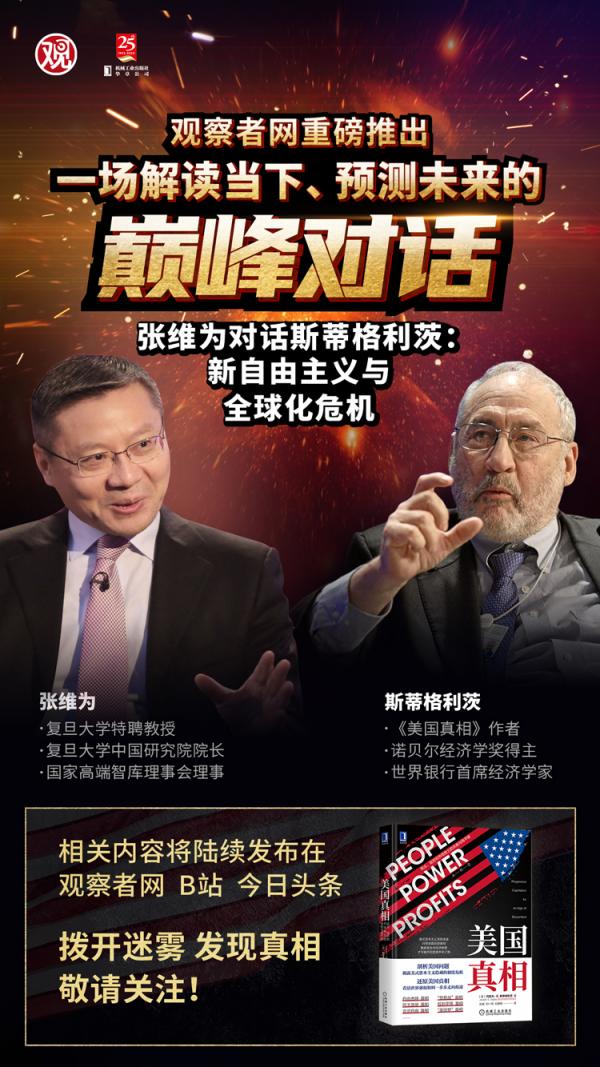
**楊晗軼:**我們從斯蒂格利茨教授開始。您的著作不久前被譯成中文,書名叫做《美國真相》。我想知道您認為其中最重要的真相是什麼,這本書曝光了什麼過去人們認識不足或者認識偏差的地方?
**斯蒂格利茨:**我認為這本書令人意想不到的地方在於,它曝光了美國市場經濟受到市場勢力壓榨的程度,企業勢力是如何壓榨消費者的,缺乏議價權的工人是如何被企業剝削的,這種利用個體脆弱性的能力。
這本書的主題是點明美國當下需要新的社會契約,在市場、國家和民間社會之間取得新的平衡,政府需要在監管和投資方面發揮重要作用。民主具有非同尋常的重要性,但近幾十年它不斷受到破壞。我們看到有人試圖壓制選民(注:通過讓某些人不要投票來影響選舉結果)。
我在書中試圖描述當下的情形,解釋一個國家怎麼會表面上號稱支持民主,實際上卻任由少數統治多數,而且毫不在乎他們的權利。絕大多數美國人希望管控槍支,希望提高最低工資,希望能享受醫保服務等等一系列改革。但我們卻什麼都沒得到。我説的大多數,是二比一、三比一的比例,但問題在於少數的剝削者,比如企業等參與剝削活動的行為方,很清楚它們的議程不受多數人支持,所以它們就設法剝奪人們的公民權,包括阻撓選民投票,用傑利蠑螈(不公正地劃分選區)褫奪選民權力等方式,通過最高法院限制政治行動,給民主套上枷鎖,在政治程序裏賦予金錢更大的權力。
**張維為:**通過對國際政治體制和制度的研究,我得出一個結論:一個社會要想達到運轉良好的理想狀態,必須要平衡三種力量:政治力量,社會力量和資本力量,使它們符合絕大多數人的利益,而不是為少數人服務。
但問題在於,或者説我擔心的是,也許美國的資本力量過於強大,通過某種方式壓倒或捕獲了社會和政治力量,所以儘管你在書中很正確地呼籲要鞏固民主,要加強制衡機制,但如果相互制衡的行政、司法和立法三權都被資本力量捕獲了,未來會發生什麼?
**斯蒂格利茨:**我這本書的核心宗旨之一是指出,當社會不平等現象過於突出的時候,制衡系統是不起作用的。我基本同意你的觀點。當社會人羣的收入和財富存在太多不平等的時候,那些擁有不成比例財富的人將以這樣或那樣的方式,掌控社會里的所有槓桿,獲得支配地位。所以這是我們的侷限性。
從政治體制的組織結構上説,是存在制衡機制的,但財富的影響力凌駕於這種機制之上。正是出於這個原因,我才呼籲把消除財富不平等作為核心議題。現在最棘手的問題在於,美國的不平等現象已經嚴重到這個地步,要怎麼逆轉這個現象,防止它永久延續下去?在這個問題上,民主或許能發揮一些作用。我們拭目以待。
**張維為:**中國有協商民主,從人民中來到人民中去,進行一輪協商,重複這個過程,再進行一輪協商,然後再重複,再協商。當前這個階段,我們正在制定新的五年規劃,毫不誇張地説在這個過程中,中國整個體制和社會的各個層面要經歷成百上千次協商,好比是供給產生需求。我好奇的是,儘管你在書中提到拜登和他的民主理念,比如促進平等和槍支管控等,得到了很大的支持,但仍然很難達成社會共識,沒有這樣的共識,就很難推動整個國家往前走。這是美國面臨的挑戰。
**斯蒂格利茨:**儘管反對的聲音非常大,但美國目前已有寬泛的共識。其實我認為最難做到的一點,是以開放的態度看待針對政策的批評。我覺得美國特別好的一個地方就是我能公開批評特朗普總統,現在其他美國人也加入我一起批評他。要不是我們還擁有自由的媒體,他早就會把信息給鉗制起來,不讓人們知道他究竟有多差,不讓人們瞭解疫情的真相。所以直到目前為止,自由媒體還算是我們的優點之一,我們能批評包括總統在內的所有人,能直截了當地説他是個騙子,因為他就是個騙子。但在許多其他國家,如果你像在美國這樣公開對總統説“你是個騙子,你扭曲了真相”,那你可能就進監獄了。美國的優點之一就是我們至少還保持着這種開放態度,這種批判精神,如果沒有這種批判元素,或許你可以取得共識,但這種共識可能是支持錯誤的政策。
**張維為:**我想提另一個問題跟斯蒂格利茨教授討論。你提到法治是美國政治體制的巨大資產。但現在出現一個問題,用我的話來説就是過度的法條主義,或者説是法律系統的僵化。比方説如果要把槍支給控制好,可能就要設法修訂憲法第二修正案,重新修改它。這涉及到修憲。那麼問題來了,修憲的門檻有多高?要在國會兩院以三分之二以上多數通過,然後還要在四分之三的州議會獲得批准。鑑於美國政治已經高度分化,這看上去幾乎無法實現。那麼既然法律框架不能動,要怎麼在現有法治條件下推動改革呢?
**斯蒂格利茨:**美國憲法沒有具體規定最高法院大法官人數。越來越多人認為最高院應該增加大法官人數。憲法關於持有武器權利的第二修正案的解釋是大約一百年前才形成的,我不太記得做出這項關鍵決定的具體日期,但我要説的是,你可以對這項修正案做出非常不同的解讀,比如我認為沒有哪個頭腦正常的人會認為它賦予你端着AK47在街上走的權利。你可能會問,立憲者的原初旨意是什麼?根本沒有原初旨意,因為當時沒人持有這種槍,它還沒有被髮明出來。所以這種遇事不決就問原初旨意的觀念——問的對象還是一羣前工業革命時代的奴隸主——這種認為應該用他們的意圖來指導21世紀的我們的想法,是非常荒謬的,是一種虛構的神話。
在我看來,今天多數美國人都認為這些文本應該得到另一種非常不同的闡釋。特朗普讓我們意識到了憲法的侷限性,規範以及法律的重要性,還有我們體制的脆弱性。我們看到了在參議院助紂為虐的情況下一個人就能製造這麼大的破壞,我認為大家都在強烈要求民主改革,以確保未來不太可能再發生這樣的事。
英文版:
Yang: Let’s begin with Professor Stiglitz. Your book has been recently translated into Chinese under the title meiguo zhenxiang, the truth about America. So I wonder what
do you consider to be the most significant pice of truth that was previously hidden or misunderstood and now you expose with this book? Professor Stiglitz.
Stiglitz: I think the surprising thing covered in the book is the extent to which the United States market economy is marked by exploitation by market power, with corporate power exploiting consumers, a lack of bargaining power of workers, so corporations are exploiting workers. The ability to exploit the vulnerabilities of individuals.So the theme of the book is what is needed is a new social contract, a new balance between market, the state, and civil society, where government needs to play an important role in regulation and investment. Democracy is extraordinarily important, but it is being undermined in recent decades. And we see the attempts of voter suppression. And I actually tried to describe what is going on, how is it that you could have a country professedly supporting democracy, having the minority rule over the majority without attention to their rights. So a vast majority of Americans want gun control, want higher minimum wages, want access to health care, a whole set of reforms. And we can’t get it. And when I say majority, 2 to 1, 3 to 1, and the problem is that a minority of exploiters, corporate and others who are engaged in exploitation know their agenda is not supported by the majority. So they have been engaged in a process of disenfranchisement which includes voter suppression, disempowerment which includes gerrymandering, and putting democracy in chains which includes using the Supreme Court to restrict what can be done, and to give more power to money in the poltical process.
Zhang Weiwei:From my study of international political systems and institutions, I’ve come to a conclusion that for an ideal, well-functioning society, it’s necessary to have a balance of three powers: political power, social power, and capital power, in the interest of the vast majority of people, rather than the minority of people..
The problem is, or my concern is, perhaps the power of capital is way too strong. It has somehow dominated or captured the social power and political power, so when you advocate rightly in your book for stronger democracy, for more checks and balances, yet if this check and balance between administrative, judiciary and legislative branches, if all three political branches are captured by the power of capital, what will happen?
Stiglitz: One of the central tenets of the book is a system of checks and balances can’t work if there are too large an inequality in the society. So I’m basically agreeing with you. When there are too many inequalities in income and wealth in society, in one way or another, those who have disproportionate wealth will get control of all the levers in society and dominate. So, that is the limitation. You can have the organizational structure in the political system of checks and balances, but they’ll be overridden by the influence of wealth. And that’s one of the reasons why I call for eliminating the inequalities of wealth as a central issue.
Now the hardest question is, given the levels of inequality present in the United States, how are you going to eliminate the perpetuation of those inequalities? And here’s where democracy may make a difference. We’ll see. Zhang Weiwei: So what we have is what we call consultative democracy, from the people to the people, one round, and to the people from the people, another round, and from the people to the people, another round. At this stage when you are producing the next five-year plan. It takes literally thousands of rounds of consultations at all levels of Chinese institution and society. It’s like a supply that produces demand. So I wonder despite the fact that as you suggested in your book that there’s so much support whether for Biden or for his democratic ideas for more equality, for gun control, yet it’s difficult to reach consensus and then build on consensus and move the nation forward. This is a challenge.
Stiglitz: There are very vocal forces or voices on the other side, but there’s a broad consensus. I think the hardest issue though is the openess to criticism of government policies. I think one of the strengths of the United States is that I can very openly criticize President Trump, and other Americans have joined in that criticism. Were it not for the fact that we have a very free press, he would have suppressed information about how bad he’s doing, suppressed information about the pandemic. So one of the strengths that we have is so far our free media, our ability to criticize everybody including the president, to call him a liar, because he is a liar, but I mean in many other countries around the world if you were to say, as publicly as many people have said, to the president that you are a liar, that you distorted the truth, you’d wind up in prison. One of the strengths of the United States is that we’ve so far been able to maintain that kind of openess, that critical element, because if you don’t have that critical element, you can get consensus but it can be behind the wrong policies.
Zhang Weiwei: But may I raise another point, a question, to discuss with Professor Stiglitz. You mentioned the rule of law in the United States which is a tremendous asset of US political system. Now the point is whether there is a kind of, what I call, excessive legalism or rigidification of the legal system. For instance, if we want to do well with this gun control, maybe you have to somehow amend this Second Amendment, revise this amendment. So it’s a constitutional revision. But again, how difficult it will be to revise the constitution? It calls for a 2/3 majority of the congressmen. And then, I don’t know, 3/4 of the all the states. So it seems almost impossible given the divided nature of American politics. So if the legal framework cannot be touched, then how can you push for these reforms on the current existing rule of law?
Stiglitz: The constitution does not specify the number of justices in the supreme court. There’s a growing sense that there will have to be an increase in the number. The Second Amendment on the right to bear arms did not have the current interpretation until maybe a hundred years ago, I don’t know when the dividing critical decision was. But you could read that particular amendment in a very different way, which I think nobody in the right mind, believes that it gives you the right to carry an AK47 around. That was not, you can say, what was the original intent? There wouldn’t be an original intent because nobody carried those guns, they hadn’t been invented. So the idea that you could ask what was the original intent of a group of people-many of whom were slave owners before the industrial revolution- what their intent was should guide us in the 21st century is an absurd notion, and it is a fiction. I think most Americans today believe those words should have been read in a very different way. Again, I think Trump has made us understand the limitations of our constitution, the importance of norms as well as laws, and the fragility of our system. Having seen how much damage one person can do with a compliant Senate. I think there is a strong sentiment to make democratic reforms that will make this less likely to happen again.
本文系觀察者網獨家稿件,文章內容純屬作者個人觀點,不代表平台觀點,未經授權,不得轉載,否則將追究法律責任。關注觀察者網微信guanchacn,每日閲讀趣味文章。