何新歷史雜記:關於歐幾里得問題_風聞
熊猫儿-2021-01-26 21:23
1、《幾何原本》譯名有問題
歐幾里得《幾何原本》,比較準確的譯名應當譯為幾何原理,據説此書希臘文的名稱希臘語:Στοιχεα,即原理之義。
但是《幾何原本》,英文書名則為theelements,即幾何元素。這個名稱來自拉丁文的Elementa,元素。
明末徐光啓、利瑪竇則把拉丁文Elementa——翻譯為“原本”。這個“原本”的意義,即本原,原始,之所以這麼翻譯,是因為明朝當時漢語還沒有“元素”或者“原理”之詞。
實際上,《幾何原本》此書與多數的所謂古希臘著作一樣,都是12——15世紀期間自小亞細亞的“希臘”(即東羅馬)地區,在被十字軍洗劫後,流散到歐洲的亞洲著作,最早傳到歐洲的可能是阿拉伯文本。
據黑格爾在《哲學史講演錄》的説法,所有的希臘著作包括《幾何原本》在內,都是通過阿拉伯人傳到歐洲的。
徐光啓、利瑪竇的譯本是根據拉丁文本翻譯的。(所據系1574年由利瑪竇老師克拉維烏斯ChristophorusClavius編纂的拉丁文版本。)
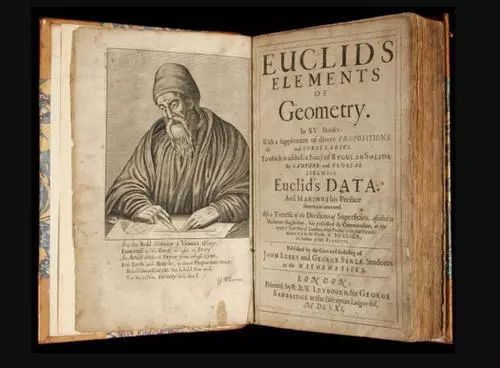
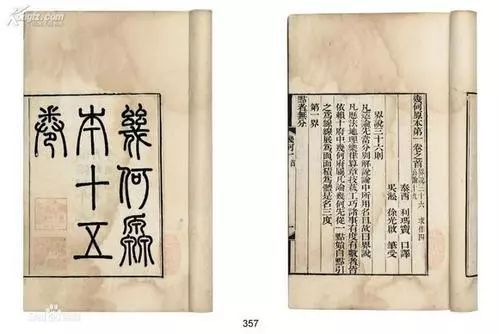
但是到19世紀末,卻據説在梵蒂岡圖書館發現了《幾何原本》的希臘文本。
又據説,19世紀末在埃及俄克喜林庫斯曾經發現大批古希臘的紙草著作,裏面包括了幾乎所有的希臘名著,包括《幾何原本》,即紙草中一頁題名“元素”的幾何證明。
但是這批所謂希臘著作的紙草文本的可信性,在西方學界也一直有人質疑。
其實,如果這些紙草文件可信,那麼既然是出土於埃及,則表明此書與雅典希臘無關,而與亞洲的“希臘”或者阿拉伯人的確有關。
2、歐幾里得,來歷不明之人
據西方主流説法,歐幾里得是埃及亞歷山大人,因此被稱為亞歷山大里亞的歐幾里得。據説他生活於托勒密一世時期,屬於亞歷山大學派。
但是,所謂亞歷山大遠征以及托勒密統治埃及的歷史基本是沒有可信性的虛妄神話傳説。而關於神奇的亞歷山大圖書館等等這些説法,也無任何可信史料支撐都屬於虛構的無稽之談。
偽希臘歷史的杜撰者把他稱作柏拉圖的學生,稱歐幾里得曾就學於雅典柏拉圖學院。但是雅典是一個非常簡陋的山城,所謂柏拉圖學院純屬子虛烏有。
阿拉伯人認為,《幾何原本》的作者並不是希臘人,而是阿拉伯地區的人。歐幾里得是阿拉伯人Naucrates的兒子,出生在提爾Tyre(即推羅,黎巴嫩)。幾何一書實際是(未必是一個人)對亞洲地區早期幾何學及邏輯學思想的系統總結。
因此,西方所稱的數學之父,歐幾里得其人和其書幾何原本,事實上都是文藝復興以後出現於歐洲,而來歷則一直不明。
3、《幾何原本》作者並非一人
據稱歐幾里得所著的《原本》成書於公元前300年,實際上,原書早已失傳。
西方學界有人認為研究者認為其實根本沒有歐幾里得這個人,認為幾何原本其實是一羣數學家以“歐幾里得”為名所寫,取名歐幾里得的原因是為了“好名聲”。
【附註:實際上,“歐幾里得”一詞是虛構的名稱,據説希臘文原意就是好名聲。“歐幾里得Euclid是希臘文Εκλεδη的英化名字,意為好名聲”。】
有人認為,歐幾里得是一個類似一羣法國數學家組成的”尼古拉·布爾巴基數學小組”,集體編撰了《幾何原本》一書。近代西方人為了杜撰一個一切科學起源於雅典希臘的神話,而臆造了幾何之父歐幾里得以及據稱同時代的物理力學之父阿基米德。
(The MacTutor History ofMathematics archive.Jean Itard.Les livres arithmétiquesd’Euclide.1962.)
實際上,關於歐幾里得的可信生平資料根本沒有。大部分關於歐幾里得的資料據説都是來自公元5世紀年時一個羅馬人普羅克洛及公元4世紀的帕普斯的評論,這兩個人的著作也是15世紀以後出現的,本身很可以。而所説的他們的年代距歐幾里得也有近千年之久。
【附註:據説普羅克洛在《對幾何原本的評論》(Commentary on theElements)中簡單的述及歐幾里得。根據普羅克洛的説法,歐幾里得屬於柏拉圖學派,將《幾何原本》集合在一起,這些著作原來是由柏拉圖的學生(特別是歐多克索斯、泰阿泰德及歐普斯的腓力等)所寫的。普羅克洛認為歐幾里得與阿基米德都是托勒密一世時期的人云雲。諸如此類這些説法查不到原始史料,毫無可信性。】
4、《幾何原本》是數學史上一部重要著作
眾所公認,《幾何原本》是數學史上一部重要的數著作。它是數學的初始基礎,總結了平面幾何五大公設,被廣泛認為是歷史上最成功的一部初等教科書。
《幾何原本》也涉及了一些關於透視、圓錐曲線、球面幾何學及數論的內容。
《幾何原本》第一次使用了公理化以及邏輯推演的論説方法,這一方法後來成了建立任何知識體系的典範,在差不多二千年間,被奉為必須遵守的嚴密思維的範例。
這本著作是數學的基礎,在西方曾經是僅次於《聖經》而流傳最廣的書籍。
其中有嚴謹的數學證明系統,是後來2300年數學邏輯構架的基礎。
《幾何原本》(Elements)共有13卷(或説15卷),是一部成熟的總結性著作。是小亞細亞地區的亞洲本土希臘學派數學的總結性著作,文藝復興時期流傳到歐洲。
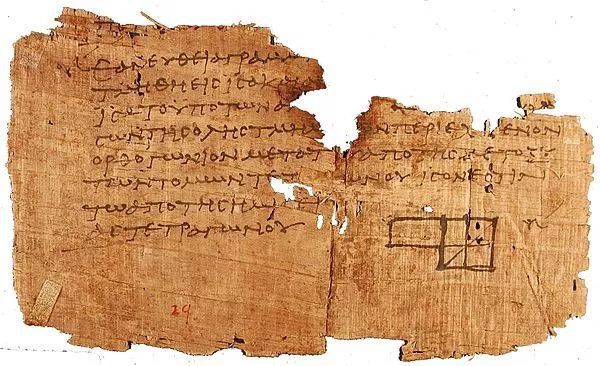
【紙莎草俄克喜林庫斯29(P.29)幾何元素殘葉】
據稱是格倫菲爾(Grenfell)和亨特(Hunt)於1897年在埃及Oxyrhynchus垃圾中發現的。該片段年代據稱為3世紀末或4世紀初,最近認為可能是公元1世紀。原件現藏於賓夕法尼亞大學圖書館(大學博物館,E2748藏品)。該文本Grenfell和Hunt於1898年曾經發表出版。
據稱,此稿是以斜體不規則的uncial字母抄寫。碎片尺寸約為85 x 152毫米。該片段系《元素》第二冊第5命題的論説,大意為:“如果將一條直線切成相等且不相等的線段,則整個不等距線段所包含的矩形以及該截面的兩點之間的直線上的正方形等於一半的正方形”。
【何新附註:
事實上,歐幾里得書名稱,更準確地説應當稱為“原理”。因為據説原書書名為希臘文∑τоιχεiα,是希臘文“定理”一詞∑τоιχεiоν的複數形式,因此原書直接的意思是“諸定理”,或者原理。
這本書的拉丁文譯本書名為Elementa,即元素。現代西方普遍沿用拉丁文譯名,所以英文翻譯為Elements,也是“元素”的意思。
而埃及紙草文本的名稱,據稱是小亞細亞地區的古希臘文字。如果其題名竟然是較晚出現的“元素”,而不是希臘的“原理”或“定理”,那麼此文本之來歷,即更加可疑。】
【附錄】《大不列顛百科全書》歐幾里得詞條
[何新按語]
這個詞條最有趣之處是,詞條承認:“歐幾里得的生平沒有資料傳留,出生地也無從查考。”但是它還是信誓旦旦地寫了那麼多有趣的內容。
【詞條原文】
Euclid歐幾里得(活動時期約公元前300,亞歷山大城)古代最傑出的數學家,以《幾何原本》(簡稱《原本》)而聞名。
這部著作從他寫作的時代一直流傳至今,對人類活動起着持續的重大影響,至少到19世紀非歐幾里得幾何出現以前,它一直是幾何的推理、定理和方法的主要源泉。
歐幾里得的生平沒有資料傳留,出生地也無從查考。
僅知托勒密一世索特爾統治時期(約公元前323~前285或前283),他在亞歷山大城教學並創辦學校。
在中世紀人們往往把他和早100年的柏拉圖時代的哲學家歐克萊得斯(Eucleides ofMega ma)混為一人。
他的《原本》是彙編了早期許多人的著作,如希俄斯的希波克拉底(前5世紀)的著作和圖狄烏斯的教科書。
其主題材料無疑取自前人的論著,但是整個著作無疑是由歐幾里得自己構思的,他融合了前人的工作併發明瞭新的證明方法。
例如在《原本》的13篇中,第5篇主要是歐多克索斯的工作,第10篇主要是特埃特圖斯的工作,但又都補充、發展了新的內容。
歐洲流傳的歐幾里得著作的拉丁文本主要來源於亞歷山大城的泰昂對《原本》的修訂本,而《原本》希臘文手稿,於19世紀初才在梵蒂岡圖書館發現。
除了《原本》外,歐幾里得還有其他著作。1916年出版的拉丁文本《歐幾里得全集》,收入了他留傳下來的全部著作。
其中有《數據》(可能是《原本》的習題)、《論圖形的剖分》、《光學》、《鏡面反射》、《現象》(講天文學、球面幾何)等。據記載,他還有4部失傳的著作:《辨偽術》是為訓練學生區別幾何推理的正確和謬誤;《衍論》,共3卷,其主要內容已失傳,據説是討論介於純理論與證明存在性的作圖題之間的問題;《二次曲線》是一部僅次於《原本》的重要著作,共4卷,它成為阿波羅尼奧斯的《圓錐曲線》頭4篇的主體內容;還有《曲面-軌跡》,可能是講形成曲面的軌跡或是曲面上的軌跡的。
歐幾里得可能不是第一流數學家,然而他是第一流的數學教師,他寫的教科書實際上持續使用了2000年之久,直到19世紀中葉發生所謂的“離開歐幾里得”運動後,才出現大批其他各種幾何學教科書。
【Euclid of Alexandria】
Euclid of Alexandria is the most prominent mathematician of antiquity best known for his treatise on mathematics The Elements.The long lasting nature of The Elements must make Euclid the leading mathematics teacher of all time.However little is known of Euclid’s life except that he taught at Alexandria in Egypt.Proclus
,the last major Greek philosopher,who lived around 450 AD wrote(see[1]or[9]or many other sources):-
Not much younger than these[pupils of Plato
]is Euclid,who put together the"Elements",arranging in order many of Eudoxus’s theorems,perfecting many of Theaetetus’s,and also bringing to irrefutable demonstration the things which had been only loosely proved by his predecessors.This man lived in the time of the first Ptolemy;for Archimedes,who followed closely upon the first Ptolemy makes mention of Euclid,and further they say that Ptolemy once asked him if there were a shorted way to study geometry than the Elements,to which he replied that there was no royal road to geometry.He is therefore younger than Plato’s circle,but older than Eratosthenes and Archimedes;for these were contemporaries,as Eratosthenes somewhere says.In his aim he was a Platonist,being in sympathy with this philosophy,whence he made the end of the whole"Elements"the construction of the so-called Platonic figures.There is other information about Euclid given by certain authors but it is not thought to be reliable.Two different types of this extra information exists.The first type of extra information is that given by Arabian authors who state that Euclid was the son of Naucrates and that he was born in Tyre.It is believed by historians of mathematics that this is entirely fictitious and was merely invented by the authors.
The second type of information is that Euclid was born at Megara.This is due to an error on the part of the authors who first gave this information.In fact there was a Euclid of Megara
,who was a philosopher who lived about 100 years before the mathematician Euclid of Alexandria.It is not quite the coincidence that it might seem that there were two learned men called Euclid.In fact Euclid was a very common name around this period and this is one further complication that makes it difficult to discover information concerning Euclid of Alexandria since there are references to numerous men called Euclid in the literature of this period.
Returning to the quotation from Proclus
given above,the first point to make is that there is nothing inconsistent in the dating given.However,although we do not know for certain exactly what reference to Euclid in Archimedes’work Proclus is referring to,in what has come down to us there is only one reference to Euclid and this occurs in On the sphere and the cylinder.The obvious conclusion,therefore,is that all is well with the argument of
Proclus
and this was assumed until challenged by Hjelmslev in[48].He argued that the reference to Euclid was added to Archimedes’book at a later stage,and indeed it is a rather surprising reference.It was not the tradition of the time to give such references,moreover there are many other places in Archimedes where it would be appropriate to refer to Euclid and there is no such reference.Despite Hjelmslev’s claims that the passage has been added later,Bulmer-Thomas writes in:-
Although it is no longer possible to rely on this reference,a general consideration of Euclid’s works…still shows that he must have written after such pupils of Plato
as Eudoxus and before Archimedes.For further discussion on dating Euclid,see for example[8].This is far from an end to the arguments about Euclid the mathematician.The situation is best summed up by Itard[11]who gives three possible hypotheses.
(i)Euclid was an historical character who wrote the Elements and the other works attributed to him.
(ii)Euclid was the leader of a team of mathematicians working at Alexandria.They all contributed to writing the’complete works of Euclid’,even continuing to write books under Euclid’s name after his death.
(iii)Euclid was not an historical character.The’complete works of Euclid’were written by a team of mathematicians at Alexandria who took the name Euclid from the historical character Euclid of Megara who had lived about 100 years earlier.