穆斯塔法·海德爾·賽義德: 只要“東突”和反巴基斯坦分子不藏匿在阿富汗,巴基斯坦就支持新政府
穆斯塔法·海德爾·賽義德接受觀察者網採訪
【採訪/觀察者網 周遠方、劉倩藜】
觀察者網:阿富汗局勢出現快速變化,有媒體分析認為,這會給巴基斯坦經濟帶來一些負面影響,包括難民衝擊和潛在恐襲對經濟環境的影響,但實際上這次塔利班的政權更迭過程比外界預測的和平,您怎麼看待局勢變化對地區安全和經濟可能帶來的影響?
**穆斯塔法:**我認為對當前局勢而言,最重要的是阿富汗國內的安全、穩定以及與周邊國家保持友好關係。只要這些方面有保障,我們就可以認為這是一個和平、平穩的權力交接過程,無論在阿富汗的境內還是境外,人的生命能夠得到尊重,人民的安全能夠得到保障,我想這應該是最重要的。
其次,是經濟和商業利益。到目前為止,阿富汗塔利班始終表示歡迎“一帶一路”倡議和中國在該地區的投資。
我認為,只要阿富汗塔利班能做到以上這幾點,目前來看,他們上台執政就不會對地區局勢產生負面影響。
當然,我們必須觀察阿富汗塔利班對中國、巴基斯坦等周邊國家的承諾是否得到遵守。因為我們不希望阿富汗為一些危害周邊國家的組織提供收容和庇護,比如如你所知,過去一些“東突”恐怖分子和一些反巴基斯坦分子曾經藏匿在阿富汗。只要這樣的事情不再發生,我們認為,阿富汗地區局勢能夠向和平、穩定的方向繼續發展。

阿富汗地圖
觀察者網:您是否認為阿富汗局勢的變化會與巴基斯坦的安全局勢產生聯動?
**穆斯塔法:**巴基斯坦在過去一直都是接收難民的“模範生”。在80年代蘇聯入侵阿富汗時,巴基斯坦就收容了數百萬流離失所的阿富汗難民。巴基斯坦是唯一一個接收了這麼多阿富汗難民的國家。所以無論在阿富汗發生什麼,最終肯定會對巴基斯坦產生一些影響。如果説巴基斯坦不會受到任何影響,那肯定是不對的,因為在我們那麼長的邊境上,經常會有雙方的人員往來。(巴基斯坦與阿富汗的邊境線長達2430公里——觀察者網注)
巴基斯坦認為,阿富汗的政府應該能夠代表阿富汗人民;任何上台執政的政府,只要得到阿富汗人民理解和支持,巴基斯坦就會支持。
同時,巴基斯坦也非常清楚自己的核心利益。我們不希望阿富汗局勢被一些有敵意國家利用,在該地區製造不穩定因素。巴基斯坦和中國在阿富汗有一些共同利益,因此我們兩國之間一直保持着密切的協調與合作。“中巴經濟走廊”就是中巴兩國共同利益的一個具體體現。中國新疆對“一帶一路”倡議而言非常重要,假如新疆受到來自阿富汗局勢的一些負面影響,這也會影響巴基斯坦的利益。
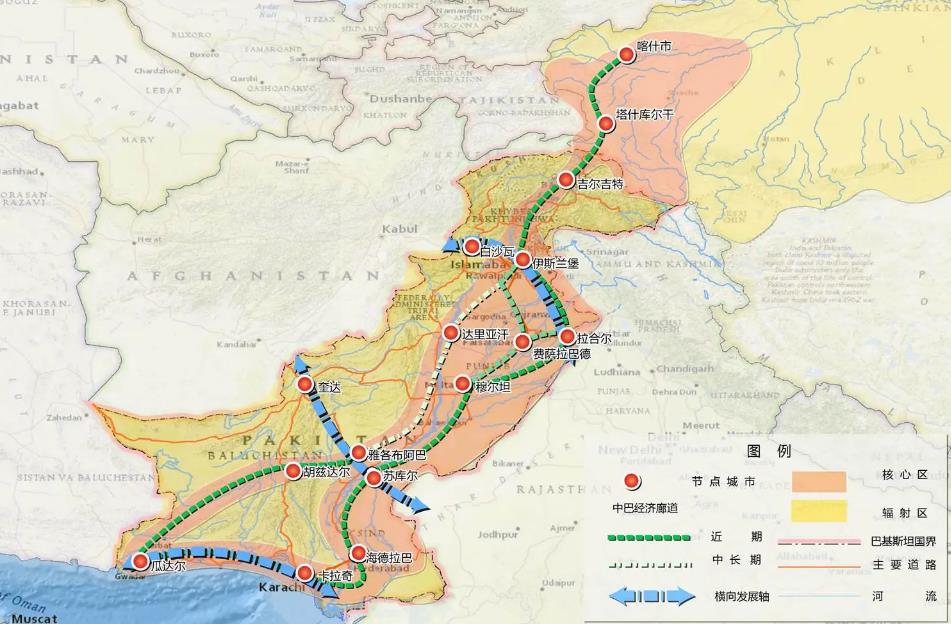
中巴經濟走廊
第二,中巴兩國面臨共同的恐怖主義威脅。中國和巴基斯坦過去都面對過恐怖主義威脅,我們都希望通過與阿富汗塔利班合作,來解決這一問題,確保未來不再有這樣的事情發生。
第三,交通要衝。阿富汗與伊朗和許多中亞國家接壤,亞洲通往歐洲的陸上交通線也可以取道阿富汗。特別是瓦罕走廊,在商業和戰略上都至關重要。打通這條路線是一個長久以來的夢想,阿富汗可以成為這條路線的一部分,巴基斯坦、中國、阿富汗在此有共同利益。如果三方能夠有良好的合作,這些共同利益是可以實現的。然而,我們也認為,美國背叛了阿富汗人民。
觀察者網:美國進入阿富汗即將滿20週年,在這20年中,美國沒有為阿富汗人民和周邊地區帶來和平,更不用説經濟發展,您認為主要原因是什麼?追求地區和平和發展是不是美國進入阿富汗的初心?
**穆斯塔法:**美國為了入侵阿富汗,花費了數萬億美元。如果這數萬億美元被投入發展教育、建設大學和醫療,今天的阿富汗將是一個全新的國家。現在這數萬億美元被用於軍事行動,使用暴力扶持一個強加於阿富汗人民的政權。
(據美國布朗大學“戰爭成本項目”(Costs of War)詳細統計,從2001年開始到2021年4月,美國在阿富汗戰爭中共投入2.261萬億美元,包括國防部用於海外應急行動的9,330億美元;國防部戰爭基本預算中另外增加的4,430億美元;用於照顧阿富汗戰爭退伍軍人的2,960億美元,以及來自國務院額外的590億美元。另外,還有5,300億美元用於支付過去20年戰爭債務利息。觀察者網注。)
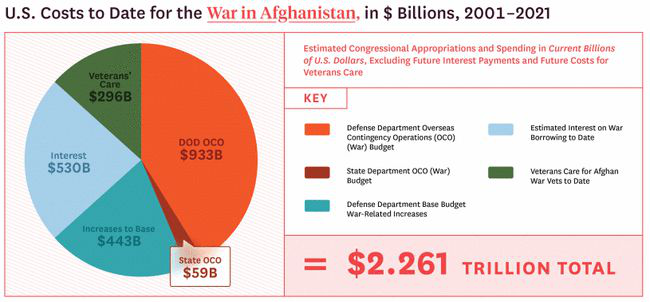
圖片來源:“戰爭成本項目”
美國入侵阿富汗,本來是為了消滅塔利班,清除和抓捕美國所謂在阿富汗的“恐怖主義領導人”。但今天我們看到,美國又與它過去要清除的所謂“恐怖分子”達成了協議,這再一次彰顯了美國外交的雙重標準:根據他們的政治利益需要,一些國家和人民有時可以被認定為“恐怖分子”;同樣因為政治利益需要,同一羣“恐怖分子”又可以搖身一變,成為國際政治中的合法參與者。
現在,我們通過(阿富汗局勢)這個例子,看到他們曾稱呼(阿富汗塔利班)為“恐怖分子”是一種誹謗。分發“恐怖分子”的標籤並不是基於任何原則性,而只是基於政治需要,這是關鍵所在。
還有一個例子,特朗普政府的第二任國務卿蓬佩奧,曾將“東突”恐怖組織從美國的恐怖組織黑名單上移除。即使它實際上就是一個恐怖組織,僅僅因為它是反對中國的,符合美國的政治利益和戰略利益,美國就把它從黑名單上刪除了。所以説,美國在該地區的政治(行動)沒有任何原則性,而是基於選擇性的、狹隘的政治利益。
我還可以做一個比較,蘇聯在1989年曾支持納吉布拉政府,當時美國和巴基斯坦支持阿富汗塔利班奪取政權。我們當時花了整整3年時間,才推翻納吉布拉政府。而今天的這個阿富汗政府的垮台,甚至3個月都不到,這又有了一個比較。
這次垮台為什麼這麼快?因為沒有任何阻力,正如你所説的,這是“和平”的交接,我們也可以從媒體上看到,沒有任何抵抗。當然也有一些暴力事件,但總體來説,沒有什麼戰鬥。我們沒有看到美國所承諾要建立的體系,還承諾要為阿富汗空軍提供訓練、加強軍隊實力,這些我們都沒看到。
我希望阿富汗能夠翻開新的一頁,一個由阿富汗人民所推動、擁有和主導的阿富汗政府能夠成立。我認為,只要阿富汗人民滿意了,中國和巴基斯坦不會對阿富汗由哪個政府執政有特別傾向。我們將攜手推進中巴經濟走廊建設,打造互聯互通和雙贏合作。
觀察者網:近期我們採訪的一位在阿富汗的中國商人認為,在阿富汗當地所見的局勢並沒有外界形容的那麼緊張,阿富汗需要的還是大量的基礎工業設施,特別是電力和交通基礎設施,近年來,周邊國家也對阿富汗進行了一些援建,巴基斯坦是否樂見地區國家和人民參與當地的和平發展和經濟建設?
**穆斯塔法:**巴基斯坦是區域經濟發展的重要支持者。在“一帶一路”倡議框架下,巴基斯坦自身正在推進大規模的經濟建設。我們正在建設一些經濟特區、道路和電力項目。對巴基斯坦來説,當務之急是與周邊國家建立良好的商業、貿易和市場準入關係,包括但不限於中國、孟加拉國、尼泊爾、斯里蘭卡,當然包括阿富汗和伊朗。
我認為阿富汗可以是巴基斯坦的一個很好的貿易伙伴,阿富汗也可以是一個(通往其他地區)的大門。無論阿富汗方面希望採取何種經濟發展模式,巴基斯坦都支持。我們將阿富汗視為合作伙伴,因為阿富汗人民需要工作,需要經濟增長,需要商業機會和就業機會。只有在阿富汗經濟復甦的情況下,以上這些才能實現。巴基斯坦正處在一個可以幫助阿富汗發展的位置上,我認為這很好。
同時,我認為還有一點非常重要,就是這種新的格局(dispensation)不會成為某些國家的掩蔽所,特別是那些試圖在阿富汗和巴基斯坦之間製造不和的國家,那些企圖干涉巴基斯坦內政的國家。我們想要地區的和平與穩定,一個和平的阿富汗,就會是一個成功的巴基斯坦;一個成功的阿富汗,就會是巴基斯坦的成功。
現在是阿富汗進行經濟革命的時候了,經濟建設應當是前進的方向,否則,我們會看到許多混亂局勢帶來的不確定性,基礎設施會因為政府的更迭而缺失。未來的根本出路在於經濟發展和增長。
(翻頁查看英文版)
Guancha: Thank you for taking your time to have the interview with us. I would like to ask you several questions regarding the situation in Afghanistan and its impact. Regarding the rapid changes in the country, some media says that it will affect the economy in Pakistan negatively. A possible influx of refugees and potential terrorist attack could dampen the economy. But in fact, the transfer of power has been very peaceful. What impact do you think the situation would bring to the regional security and economy.
Mustafa: I think that the most important things are stability, internal security, and friendly relations with the neighboring countries. As long as that is there, I think that a friendly and peaceful transition of power where everyone is alive, where the human lives are given priority, where the people’s security is given priority, both inside Afghanistan and outside Afghanistan. I think that should be on the top of the list. After that, secondary is economy and commerce. And so far, the Taliban has welcomed the Belt and Road Initiative and Chinese investment in the region. I think that as long as these ingredients are there, this is no negative effect in the region. As of now, however, we also have to see that the commitments which the Afghan Taliban had made to China, to Pakistan, to neighboring countries, a gap, because we do not want Afghanistan to give refuge to some organizations which are against the neighboring countries. As you know, that in the past there have been some anti- Pakistan elements in Afghanistan.
So as long as such things are not repeated again, we think that we can move forward peacefully in regard to Afghanistan and the region can still continue to move forward.
Guancha: What about Pakistan, specifically? Will the security situation of Afghanistan affect the local situation in Pakistan?
Mustafa: Pakistan has been the model host to refugees in the past. When the soviet invasion took place in the late 80s, early 90s, Pakistan hosted millions of Afghan refugees who were displaced from their homes in Afghanistan. We were the only country that hosted so many refugees from Afghanistan. Whatever happens in Afghanistan will, certainly, at the end of the day, have some effect on Pakistan. It would be wrong to say that Pakistan remains unaffected because we neighbour with them. On our border, a lot of the time, people come and go. Pakistan believes that the government in Afghanistan should be representative of the Afghan people. And the government should have support of the people of Afghanistan. And Pakistan will support no matter which government comes into power as long as the people who understand that happy.
But Pakistan is also very clear on its core interests. We do not want Afghanistan to be used by hostile countries to create instability in the region. We, Pakistan and China have some shared interests in Afghanistan. And that’s why there’s been close coordination and close cooperation between both the countries. Some examples of the shared interests are the China Pakistan Economic Corridor (CPEC).
Now, the CEPC is shared interest of China and Pakistan, because if Xinjiang is negatively affected from Afghanistan, that affects Pakistan. Because Xinjiang is also very important for the Belt and Road initiative. Secondly, Pakistan and China have a shared threat of terrorism. China has also experienced terrorism in the past. So has Pakistan. In Afghanistan, we have a shared challenge of terrorism, which we want to work with the Taliban to address to make sure that there is no a such thing in the future. Number three, connectivity. Afghanistan have borders with a lot of central Asian countries, and also eventually with Iran. The route to Europe can also be through Afghanistan. So that for connectivity, for the Wakhan Corridor, which is very important commercially and strategically. That the dream of connectivity is there, and Afghanistan can be a part of that. So we have some shared interests there. And these shared interests can be achieved. If there is good trilateral cooperation, in Afghanistan. However, we also believe that, the United States has betrayed the people of Afghanistan.
**Guancha:**Talking about the U.S., it entered Afghanistan 20 years ago and throughout the years, it has not brought peace to either people of Afghanistan or neighboring countries and regions, let alone economic development. Why is that? Isn’t the pursuit of regional peace and development the initial aim of the U.S. by entering Afghanistan?
Mustafa: You see, the United States has spent trillions of dollars, trillions of others on the invasion of Afghanistan. If those trillions of dollars had been spend on education, universities, health care, Afghanistan today would be a new country. It would be a very good one. But those billions of dollars was spent on military, on violence, and on imposing regime on the Afghan people. As you know very well, the US invaded Afghanistan to remove the Taliban, to remove and to catch the terrorist leaders in Afghanistan.
But today, the United States has done a deal with the same so-called “terrorists” that it removed before. We see that the U.S. diplomacy has double standards. Sometimes when it suits them, some countries and people can become terrorists. But then when it suits their political interests, then those same terrorists can become a legitimate actor in international politics.
We see through this example that casting the aspersion of terrorist, the label of terrorists, is not based on principle, but it is based on politics. That is the key. You can take another example, madam. Mr.Pompei, the second foreign secretary of the US in the previous government led by trump, removed ETIM from the terrorist blacklist. And even though it is a terrorist organization, because it is anti-China, they were removed from the blacklist. Because it supports us political strategic interests. We see that the U.S. politics in the region is not based on principles, and on merit is based on selective, narrow political interests.
And you can see from a comparison I would like to make, if you allow. When the Soviet-backed government in 1989, under the leadership of President Najibullah, was there, it took 3 years for it to fall. At that time the Afghan Taliban was called the “mujahadeen” , and they were supported by Pakistan and United States. But at that time that government took 3 years to fall. But this government, it did not even take 3 months to fall.
So there is a comparison. And this time, the reason why it is so fast was because there was no resistance. We can see on the media that as you very right, he said it was peaceful, because there was no resistance. Predominantly, there was some violent incidents, but overall, there was no fight. We see that the institutions which had been promised to be built by the United States were not there. The capacity was not there. The training (was not there). Afghan army had an air force. I did not see any (improvement) of that air force. I hope that we can see and turn a chapter, a turn a new leaf in Afghanistan, a country which is driven by people of Afghanistan, which is owned by the people of Afghanistan, and which is led by the people of Afghanistan. As long as the people of Afghanistan are happy, I think that China and Pakistan have no favorites in Afghanistan. We will cooperate to take forward connectivity, see back, and women cooperation.
**Guancha:**Recently, we have interviewed a Chinese businessman in Afghanistan. He told us that the situation in Afghanistan is not as tense as described by the outside world. What Afghanistan still needs is a huge number of basic industry facilities, especially electricity and transportation infrastructure. We know, in recent years, some neighboring countries have lend help to Afghanistan for recovery and reconstruction. In your opinion, is Pakistan happy to see regional countries and people taking the lead in peaceful development and economic development of the region or not.
Mustafa: Pakistan is a big proponent of economic development. Pakistan itself is undergoing massive economic development, particularly in the case of the Belt and Road initiative. We are developing special economic zones, roads and power projects. For Pakistan, it is imperative that it has good economic relationship of commerce, trade and market access of neighboring countries, including but not limited to China, Bangladesh, Nepal, Sri Lanka, and Afghanistan, and Iran.
I think that Afghanistan can be a very good partner for trade, and Afghanistan also can be a gate. Pakistan supports any economic development that I understand which one to take. In fact, I see a partner in Afghanistan, because people of Afghanistan, they need jobs, economic growth, business opportunities and employment opportunities . And that can only happen if we try to revive the economy. Pakistan is in a position where it can do this. It can assist the one is done. So I think that’s very good. And also, I think what is important is that this new dispensation will not have safe havens of other countries, other countries which were trying to so discord between Afghanistan and Pakistan, countries which have interfered in Pakistan’s internal affairs. And, we want peace and stability and a peaceful Afghanistan is a successful Pakistan. A successful Afghanistan is Pakistan’s success. Economy is the way forward. Right now is the time for an economic revolution in Pakistan. Because otherwise, we see that a lot of the basic amenities are missing because of the change in government. There is a lot of uncertainty in chaos. We feel that the way forward lies in economy and economic growth.
本文系觀察者網獨家稿件,文章內容純屬作者個人觀點,不代表平台觀點,未經授權,不得轉載,否則將追究法律責任。關注觀察者網微信guanchacn,每日閲讀趣味文章。