周波:美撤軍後的阿富汗是中國的黃金機遇
【文/周波】
塔利班接管阿富汗的速度之快、範圍之廣,引起了西方的反思:哪裏做錯了?這場耗費數萬億美元進行的長達二十年的戰爭,怎麼會以如此不光彩的方式走到盡頭?中國卻正在向前看—準備填補由美國倉促撤退留下的空白,抓住一個黃金機遇。
雖然北京還沒有正式承認塔利班為阿富汗新政府,但在週一發表聲明説,中國“尊重阿富汗人民自主決定自己的前途命運”,並將發展“與阿富汗的友好合作關係”。
這一信息很明確:北京對與塔利班建立更緊密的關係幾無顧慮,並準備在阿富汗這個現在幾乎被美國拋棄的國家面前,表明自己是最具影響力的外部參與者。
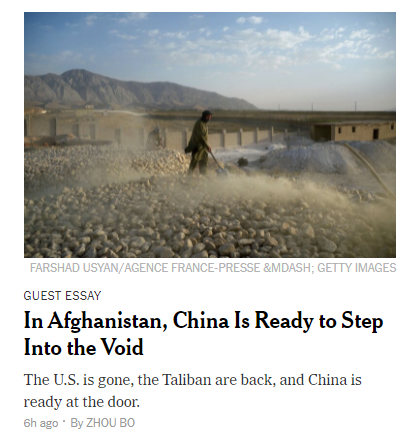
英文原文刊載於紐約時報8月21日版,截圖來自紐約時報
與美國不同,中國在阿富汗問題上沒有包袱。自美國入侵以來,中國就一直在阿富汗問題上保持低調,不願意在任何強權政治中充當美國的副手。北京眼看着華盛頓在阿富汗的戰爭變成混亂且代價高昂的泥沼。與此同時,中國向阿富汗提供了數百萬美元的援助,用於醫療救助、醫院、太陽能發電站等。在此期間,北京一直在促進中阿貿易關係,最終成為阿富汗最大的貿易伙伴之一。
隨着美國撤軍,中國可以提供喀布爾最需要的政治中立和經濟投資。阿富汗同樣也擁有中國最看重的基礎設施建設和工業建設的機會—中國在這些領域的能力可以説是無與倫比—以及獲得價值1萬億美元未開發礦藏的機會,其中包括鋰、鐵、銅、鈷和黃金等關鍵工業金屬。儘管有專家提出,中國在一個安全程度較低的阿富汗進行投資並非戰略重點,但我認為並非如此。
中國企業以投資於不太穩定的國家並獲得回報而聞名。當然這並非總是一帆風順,但中國有耐心。儘管美軍的存在一定程度上阻止了恐怖組織將阿富汗作為避風港,但美軍的撤離也意味着與塔利班長達20年的戰爭已經結束。因此,中國大規模投資的障礙就消除了。當然,中國是世界工業金屬和礦產的主要買家,需要這些礦產資源幫助經濟發展。
中國目前的長期戰略投資計劃之一是“一帶一路”倡議,旨在為整個地區的基礎設施提供資金和建設。迄今為止,阿富汗一直是這個巨大拼圖中具有吸引力但缺失的一塊。如果中國能夠將“一帶一路”從巴基斯坦延伸到阿富汗,例如修建一條從白沙瓦到喀布爾的高速公路,就能開闢一條通往中東市場的較短的陸路。一條穿過喀布爾的新路也會讓印度對“一帶一路”的抵制變得無足輕重。甚至在接管喀布爾之前,塔利班就承諾要保護中國在阿富汗的投資。
北京現在還可以對阿富汗的政局施加更大影響。這個國家的歷史告訴我們,很少有一個派別能控制整個國家。鑑於塔利班閃電式接管,發生一些內亂也有可能。在聯合國安理會五個常任理事國中,中國已經是向聯合國維和行動派遣人員最多的國家,還向聯合國註冊了8000名維和待命官兵,這使中國有望成為最大的維和部隊派遣國之一。如果聯合國維和部隊被部署到阿富汗,幾乎可以肯定的是,來自友好鄰國中國的維和部隊將比那些遠道而來的外國軍人更受歡迎。
在阿富汗發揮影響力還意味着,北京在防止反華組織在阿富汗立足方面處於更有利的地位。中國最主要的擔心是“東伊運”。根據中國政府的報告,該組織最初起源於阿富汗。按照聯合國的説法,“東伊運”在本世紀初得到了塔利班和基地組織的支持。一些學者和專家懷疑該組織是否有能力煽動暴力或它是否還繼續存在。但是,中國外長王毅7月份會見塔利班領導人巴拉達爾時表示,希望塔利班與東伊運“劃清界限”,因為該組織對“中國國家安全和領土完整構成直接威脅”。王毅還表示,希望塔利班“樹立正面形象,奉行包容政策”—這是一個信號,表明中國希望塔利班兑現其“包容性”治理的承諾。作為回應,巴拉達爾承諾,塔利班決不允許任何勢力利用阿富汗領土做危害中國的事情。
當然,阿富汗和平與穩定的關鍵,部分也在於巴基斯坦。阿富汗前總統卡爾扎伊曾把阿巴形容為“連體嬰兒”,表示兩國雖然近在咫尺,但並不總是目標一致。在很大程度上,巴基斯坦對阿政策的戰略目標是確保喀布爾是一個友好的政府,並削弱印度在阿富汗日益增長的影響力。確保巴基斯坦和阿富汗關係良好符合北京的自身利益,尤其有利於“一帶一路”的成功。
中國在巴基斯坦擁有巨大的影響力並不是什麼秘密。中國知道自己的分量,也知道未來的需求,在6月份就承諾將繼續幫助巴阿兩國發展和改善關係。
最後,即便美國正在撤離,北京和華盛頓仍有機會為建設一個穩定的阿富汗共同努力。儘管中美之間存在分歧,兩國在阿富汗問題上已經開展了一些合作,例如聯合培訓外交官和技術人員。兩國都不希望看到阿富汗陷入內戰。兩國都支持“阿人主導、阿人所有”的政治解決方案。因此,阿富汗有望成為兩個競爭巨人的合作點。 週一,王毅在與美國國務卿布林肯通話時表示,中國願同美國合作,“推動阿富汗問題實現軟着陸”。
阿富汗一直被視為“帝國墳場”—從亞歷山大大帝、大英帝國,到蘇聯和今天的美國,概莫能外。現在中國來了,帶來的不是炸彈,而是建設藍圖。中國有機會證明這一詛咒能被打破。
(本文由中國論壇執委韓樺翻譯。英文原文見紐約時報2021年8月21時評頭條,翻頁可見。)
In Afghanistan, China Is Ready to Step Into the Void
By Zhou Bo
The speed and scope of the Taliban’s takeover in Afghanistan have prompted introspection in the West over what went wrong, and how, after billions of dollars spent on a 20-year war effort, it could all end so ignominiously. China, though, is looking forward. It is ready to step into the void left by the hasty U.S. retreat to seize a golden opportunity.
While Beijing has yet to formally recognize the Taliban as Afghanistan’s new government, China issued a statement on Monday saying that it “respects the right of the Afghan people to independently determine their own destiny” and will develop “friendly and cooperative relations with Afghanistan.”
The message here is clear: Beijing has few qualms about fostering a closer relationship with the Taliban and is ready to assert itself as the most influential outside player in an Afghanistan now all but abandoned by the United States.
Unlike the United States, China brings no baggage to the table in Afghanistan. China has kept a low profile in the country since the U.S. invasion, not wishing to play second fiddle to the United States in any power politics. Beijing watched as Washington’s foray in Afghanistan became a messy and costly morass. In the meantime, China provided Afghanistan millions of dollars in aid for medical assistance, hospitals, a solar power station and more. All the while, Beijing was fostering stronger trade relations, eventually becoming one of Afghanistan’s largest trading partners.
With the U.S. withdrawal, Beijing can offer what Kabul needs most: political impartiality and economic investment. Afghanistan in turn has what China most prizes: opportunities in infrastructure and industry building — areas in which China’s capabilities are arguably unmatched — and access to $1 trillion in untapped mineral deposits, including critical industrial metals such as lithium, iron, copper and cobalt. Though critics have raised the point that Chinese investment is not a strategic priority in a less secure Afghanistan, I believe otherwise.
Chinese companies have a reputation for investing in less stable countries if it means they can reap the rewards. That doesn’t always happen so smoothly, but China has patience. Although the presence of U.S. troops went some way toward preventing armed groups from using Afghanistan as a haven, their exit also means that a 20-year war with the Taliban has ended. Therefore the barriers for Chinese investment on a large scale are removed. China is of course a major buyer of the world’s industrial metalsand minerals to fund its economic engine.
One of China’s current long-term strategic investment plans is the Belt-and-Road Initiative, an effort to finance and build infrastructure across the region. And Afghanistan until now has been an attractive but a missing piece of the enormous puzzle. If China were able to extend the Belt-and-Road from Pakistan through to Afghanistan — for example, with a Peshawar-to-Kabul motorway — it would open up a shorter land route to gain access to markets in the Middle East. A new route through Kabul would also make India’s resistance to joining the Belt-and-Road less consequential.
Even before its takeover of Kabul, the Taliban had promised to protect Chinese investments in Afghanistan.
Beijing is now also positioned to hold greater influence over the country’s political landscape. Afghanistan’s history tells us that one group is rarely in control of the entire country, and given the Taliban’s lightning takeover, it’s reasonable to expect some civil strife. China — already the largest troop contributor to U.N. peacekeeping missions among the five permanent members of the United Nations Security Council — has also registered a peacekeeping standby force of 8,000 troops — a move that could make it one of the largest contributors overall. If a U.N. peacekeeping mission is deployed to Afghanistan, Chinese peacekeepers, coming from a friendly neighboring country, will almost certainly be more welcome than those from afar.
Becoming an influential player in Afghanistan also means that Beijing is better positioned to prevent what it considers anti-Chinese groups from gaining a foothold in the country. A primary concern of China is the East Turkestan Islamic Movement. According to a Chinese government report, the group had early roots in Afghanistan. According to the U.N., it received Taliban and Al Qaeda support in the 2000s. Some scholars and experts question whether the group has the capacity to instigate violence, or whether it even continues to exist. Still, China’s foreign minister, Wang Yi, said in a July meeting with Mullah Abdul Ghani Baradar, the deputy leader of the Taliban, that he hoped the Taliban would “make a clean break” with the East Turkestan group because it “poses a direct threat to China’s national security and territorial integrity.” Mr. Wang also expressed hope that the Taliban would “build a positive image and pursue an inclusive policy” — a signal that China wants the Taliban to make good on its promise of “inclusive” governance.
In response, Mr. Baradar promised that the Taliban would never allow any group to use the Afghan territory to engage in acts harmful to China.
The key to Afghanistan’s peace and stability, of course, also lies partly in Pakistan. Despite their proximity, the “conjoined twins,” as described by the former Afghan president Hamid Karzai, don’t always look in the same direction. Pakistan’s Afghanistan policy is driven largely by the strategic goals of ensuring a friendly government in Kabul and undercutting India’s increasing influence in Afghanistan. It is in Beijing’s own interest — not least for the success of Belt-and-Road — to ensure that Pakistan and Afghanistan are on good terms.
It is no secret that China already enjoys strong influence in Pakistan. Anticipating a more prominent role and future necessity, Beijing pledged in June to continue helping develop and improve relations between the two countries.
Finally, even though the United States is leaving, there is an opportunity for Beijing and Washington to work together for a stable Afghanistan. China and the United States, despite their differences, have enjoyed some cooperation in Afghanistan already — for example, jointly training diplomats and technicians. Neither country wishes to see Afghanistan slide into a civil war. Both of them support a political solution that is Afghan-led and Afghan-owned. Therefore, Afghanistan provides an area for the two competing giants to find some common cause.
When Mr. Wang spoke to Secretary of State Antony Blinken on Monday, he said China stood ready to work with the United States to “push for a soft landing of the Afghan issue.”
Afghanistan has long been considered a graveyard for conquerors — Alexander the Great, the British Empire, the Soviet Union and now the United States. Now China enters — armed not with bombs but construction blueprints, and a chance to prove the curse can be broken.
本文系觀察者網獨家稿件,文章內容純屬作者個人觀點,不代表平台觀點,未經授權,不得轉載,否則將追究法律責任。關注觀察者網微信guanchacn,每日閲讀趣味文章。