張維為:對西方民主模式,我們一點也不羨慕,甚至有點……
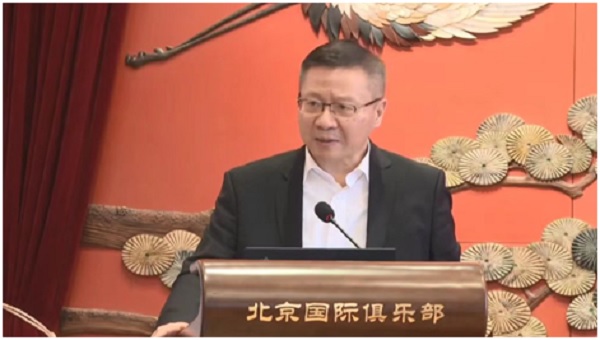
復旦大學中國研究院院長張維為在“中外學者談民主”高端對話會發表講話
張維為:
感謝王冠,感謝各位記者出席本次民主問題討論會。我的演講題目是《民主:中國與美國的比較》。
我們知道民主在很多方面是具有爭議的。如果問美國人“中國是不是民主國家”?大多數人可能會説“不,中國是一個專制國家”。如果問中國人:美國是不是民主國家,今天的多數中國人會説:“美國?民主?不,美國是金錢政治,不是民主,是錢主。”
那麼有沒有可能擱置爭議,就民主問題展開一個有意義的學術討論呢?或許我們可以嘗試用一個暫時的定義。在這裏,我想引用美國亞伯拉罕·林肯總統的話,就是“民有、民治、民享”。我將以這三個標準逐項檢驗,對比中美民主孰優孰劣。
先看“民享”。我們最近看到達利亞研究諮詢公司就民主問題發佈的調查結果。在中國,13%參與調查的人認為政府是服務於少數人的,也就是説絕大多數、80%以上的人認為政府是為大多數人民服務的。在美國,有52%的人,即超過一半的人,認為政府是服務於少數人的。
我們可以再看一下中國著名的鐘南山院士給出的一個研究結果。幾天前,他表示,如果你生活在中國,就免於感染新冠病毒而死的自由而言,中國至少比美國安全606倍,就免於感染新冠病毒的自由而言,中國要比美國安全1678倍。這個計算很簡單,如果我們看新冠死亡人數,以絕對數值計算,美國的死亡人數大約是中國死亡人數的170倍,但中國人口是美國人口的4.2倍之多。因此,就新冠病毒感染死亡率而言,中國比美國安全600多倍。
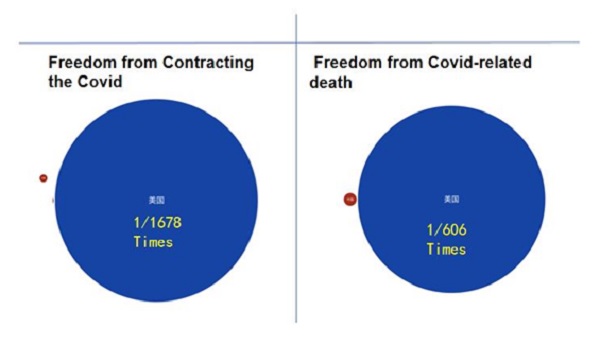
中美新冠病毒致死人數對比
接下來看家庭淨資產中位數。確實,四十年前中國人生活水平、財富水平比美國要低得多,但是現在我們可以看到一個有趣的對比,這個是有關家庭淨資產中位數的數據。我們看家庭平均淨資產,美國的數值比中國高,但是看中位數,2019年美國接近10萬美元,大約可換算成70萬人民幣。那麼在中國呢?中國比美國的數據要高一倍。當然,這是中國城鎮家庭的數據,我們現在還沒有中國農村家庭的數據,希望明年能拿到相關數據,我們再進行對比。中國農村生活水平的提升速度也比我們預想中快。
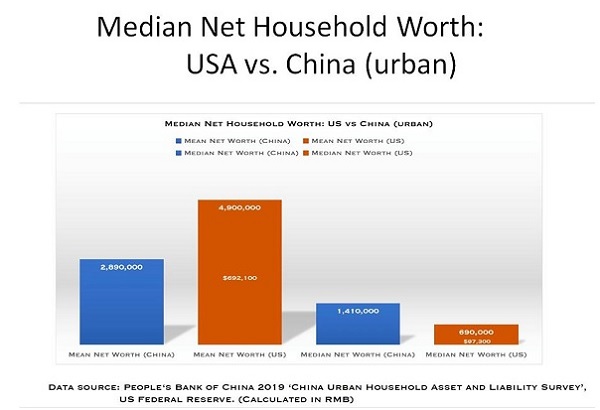
中美家庭淨資產對比
接下來,這是著名皮尤研究中心的調查,類似的調查可以追溯到五年、十年前。其中,2019年,中國91%的受訪者相信中國走對了路,美國41%的受訪者認為美國走對了路,而英國只有21%,法國只有20%,這些國家一定出現了很多人權問題,從民調結果我們就可以看出來,他們對國家的方向不滿意。這是國際知名民調機構給出的結果。我可以很確定地説,就“民享”而言,中國模式、中國政治體制、中國民主制度已經比美國模式做得好很多。
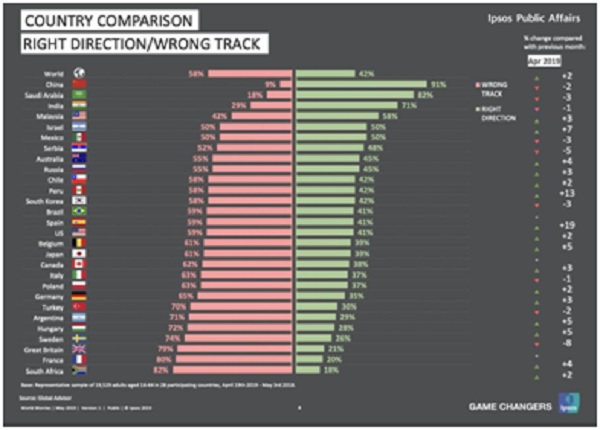
認同本國發展方向的情況對比
就“民有”來説,我這裏就用一個數據,中國公務員大約90%都來自普通家庭。而美國呢?用諾貝爾獎得主斯蒂格利茨的話説,“美國現在是1%人所有、1%人所治理和1%人所享用的”。大多數人都同意,美國是富人主導的國家。
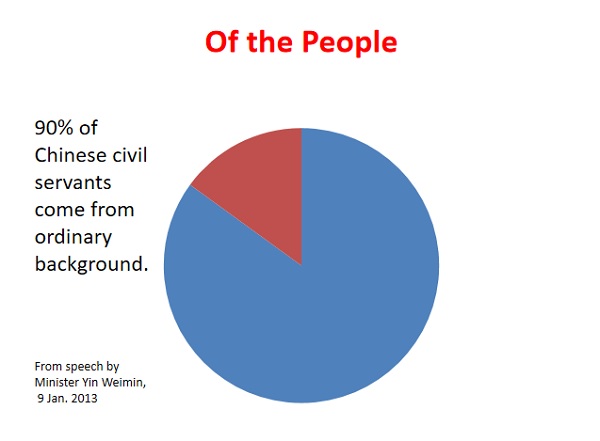
中國90%的公務員來自普通家庭
“民治”這一點是最具爭議性。在當今西方的政治話語體系中,多黨體制、普選權這些就等同於“民治”。但是從中國的角度,就像剛才李世默先生提到的,這都是一些程序。程序(民主)與實質(民主)可能是一致的,也可能差之千里。因此中國採取的方法是先探索實質(民主),相應的程序會應運而生。我們自古的傳統哲學就是“道”和“術”,“道”指更宏觀的目標和原則,“道”在“術“之上,”“道”是管理程序的。這也就是為什麼中國能夠推行程序的改革,而很多西方所謂自由民主國家卻不能,因為他們的程序過於僵化。
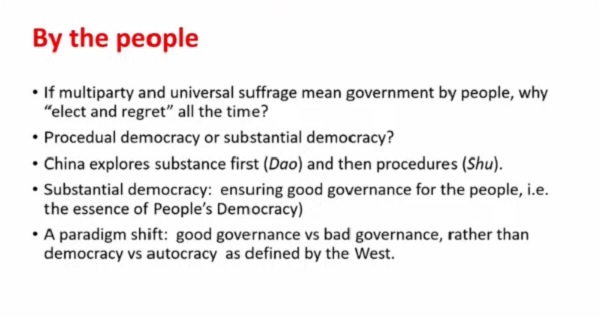
對美國“民治”的疑問
如果我們看實質民主,中國可以説是確保良政善治,這十分重要。我大約在十五、二十年前提出一個觀點:我們需要一種重大的範式轉變,這種轉變就是從西方界定的“民主還是專制”範式轉到“良政還是劣政”範式,而實質民主就是要確保良好的政治治理。這正是中國在做的,且做的不錯。
我們可以接着看一下達利亞研究諮詢公司關於“民主赤字”研究結果。在中國,有84%的人認為民主重要,有73%認為中國是民主國家,所以民主赤字為11%。在美國73%的人認為民主很重要,僅有49%認為美國是民主國家,美國的民主赤字率是24%。達利亞研究諮詢公司的這個調查是丹麥前首相拉斯穆森委託進行的,在座各位都知道拉斯穆森對中國的政治體系懷有很深的敵意;這個結果體現出,在大多數美國民眾的眼中,“民治”並沒有在美國得到實現。
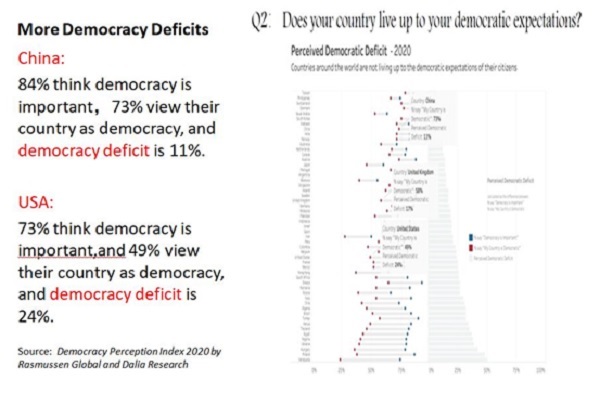
中美兩國人民對本國民主的看法
從皮尤的另一個調查結果中我們能看出,在美國的民調中,很少有人認為美國對於其他國家而言是一個好的民主典範,這項調查在大概20多個國家進行了民調。51%認為美國曾經是一個民主模範,但是現在已經不是,72%的美國人並不認為美國民主是其他國家的一個良好典範。如同剛才馬丁·雅克先生也提到的,美國一定需要很多勇氣,好像一切都沒有發生過,沒有什麼“國會山事件”,一切都像沒發生。實際上,即使在美國國內,也有很多人在反思美國民主的問題。
如果美國要舉辦民主峯會,我希望它首先討論的是:“民主到底出了什麼問題?”,這是《經濟學人》曾經用過的封面故事,其中引用了我説的一句話,“美國民主有很大的問題,它老是選出二流的領導人”,其實我當時的原話是“它老是選出三流的領導人”。不幸的是,這就是現實。
中國共產黨是一個“整體利益黨”,而西方政黨大都是“部分利益黨”。中國公元前221年成為一個統一的國家。這是一個“百國之合”的國家,歷史上一直實行“統一的執政集團”,如果不採取這樣的制度,那麼國家就會四分五裂。
1911年後中國嘗試了美國政治模式,結果陷入軍閥混戰的局面,每個軍閥背後都有西方勢力的支持。中國共產黨是中國“統一執政集團”傳統的延續和發展。如果沒有中國共產黨,中國就會變成一盤散沙。
中國歷史上開創了通過科舉考試選拔治國人才的傳統,現在中國的幹部選拔方式是“選拔+選舉”。中國共產黨中央政治局委員,尤其是常委,大多擔任過兩個省的一把手,治理過至少一億人,中國領導層可以説是當今世界上執政能力最強的領導班子。
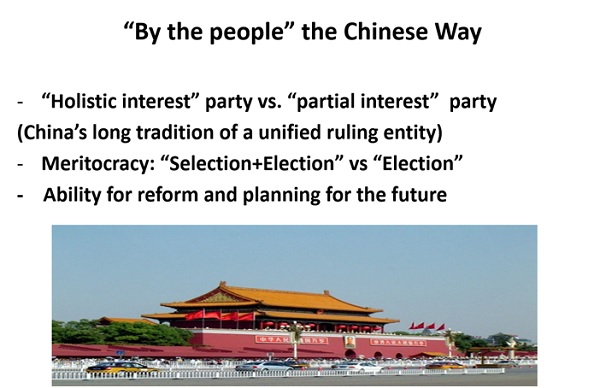
中國方式:“以民為本”
如果要進行改革,我們的政黨必須要代表人民的整體利益。為什麼西方很難推行改革或者根本沒法改革:誰要改革,就可能要下台。改革的關鍵就在於克服既有的利益羈絆,只有一個代表着絕大多數人利益的政治力量、政治機構,才有能力突破重重困難推動改革。
中國是改革的“專家”,我們隨時都在進行着改革。我認為西方也應該好好地思考一下如何改革自身的政治體制,否則就會江河日下。另外作為人民“整體利益”的代表,它也能夠放眼未來,為未來5年、10年、100年、下一代進行規劃,這是中國政治體制的優勢。
除了“民有、民治、民享”,我還從中國經驗中提取了幾點經驗,這是林肯所不知道的。比方説,“民策”,也就是 “to the people”,或者叫“from the people, to the people”, 即“從羣眾中來,到羣眾中去”的民主決策過程。
如果我們對比中美兩國政治決策的質量,我認為中國政治決策的質量明顯高得多。我們採用民主集中制,這是從蘇聯學來的,然後結合中國實際進行再創造。舉個例子,中國如何制定五年計劃?決策過程大體上要花費一年半的時間,這個過程中包含數百輪磋商,智庫內智庫外、黨內黨外。在這個全過程民主中,我們不僅制定計劃,還要付諸於實踐,並通過實踐與檢驗和調整。
在座的大多數人在中國待得有些年頭了,一定知道每年春季舉行的兩會,兩會要討論和審議五年計劃和年度計劃的落實情況。在每年11月或12月的中共中央經濟工作會議中,我們又會對計劃的執行情況進行評估。兩會中,總理在政府工作報告中都會明確指出每一項工作的落實完成情況。報告很誠懇,中國政府工作報告的質量遠高於美國總統的國情諮文。中國政府工作報告中的每一條,都與百姓息息相關。
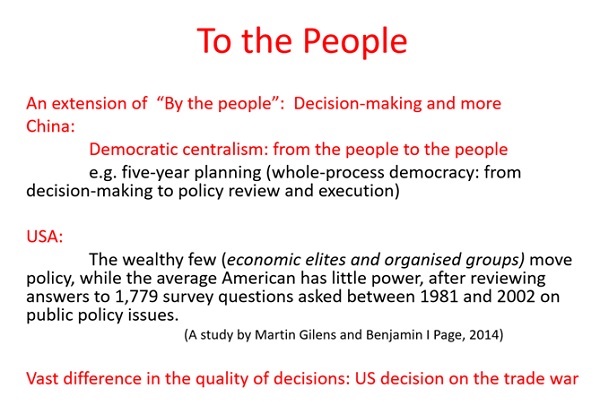
“民策”:中美決策質量的巨大差異
對於美國,馬凱碩剛才也提到普林斯頓大學教授的研究結果,在1981年至2002年的1779個調查結果顯示,美國的富豪階層能夠影響公共決策,而普通民眾對於決策幾乎沒有任何影響。這不僅僅涉及每四年選總統,而是你的決策在多大層面上能夠反映人民的意願。
反觀中國,我們會“從羣眾中來,到羣眾中去”循環往復,進行多輪的磋商,徵詢意見,從而確保這個政策是成熟的。我經常和英國朋友開玩笑,你們為什麼要進行老套的全民公投,我們現在是5G時代,而你們還處在2G時代。投票時,一方僅比另外一方多了3%多一點,但已經給英國帶來了巨大的社會分裂。如果你們採取協商民主、採用民主集中制這樣的中國模式,即使有30%的差異,我們最後也能達成共識,一起推動國家進步。
最後就是“民依”,也就是“with the people”,即“依靠人民,與人民在一起”。習主席多次強調永遠與人民在一起,這不是一句空話,而是要落實在行動上,每一位政治局委員都有自己的聯繫點,他們需要定期到這些地方去進行考察調研。最終的目的是要保證政治力量、社會力量、資本力量實現一種有利於絕大多數人民的平衡,否則制度就會出問題。
我認為,在美國,這三方力量最終是一種有利於少數富人的平衡,我想中美的政治體制的差別,可以用一句話説清楚,那就是最富的100箇中國人不可能左右中共中央政治局,而美國最富有的100個人、甚至不到100人,就可以左右白宮。因此美國需要進行認真的政治體制改革,否則美國將進一步走衰。
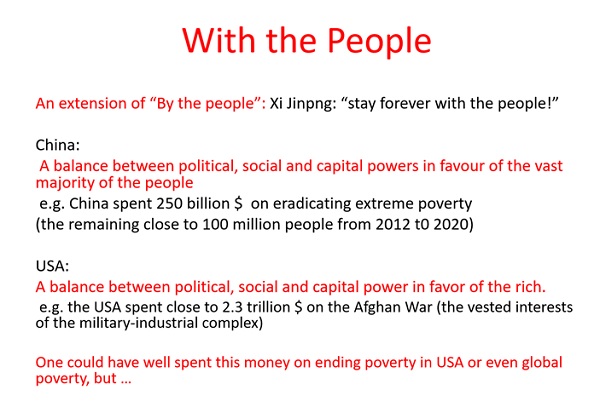
“民依”:中國共產黨一直走的是“與人民在一起”的道路
我最後想到一個令人不安的案例,就是美國過去20年,在阿富汗戰爭中揮霍了2.3萬億美元:殺害、損毀、踐踏人權。相比之下,中國自習近平主席主政以來,花了約2500億美元讓將近1億人脱貧。我們僅花費了阿富汗戰爭十分之一的錢,就消除了中國最後的極端貧困。為什麼美國不能把這2.3萬億美元花在消除美國的貧困上?這筆鉅款如果結合實際情況採用中國模式的話,理論上,我們可以在全球範圍內消滅貧困,但美國卻選擇將這些錢花在阿富汗戰爭,花在殺戮、破壞、侵犯人權。為什麼?這該如何解釋?艾森豪威爾總統在上世紀50年代就提到這一點,那就是美國軍工複合體綁架了美國的政治制度,他們通過戰爭賺得盆滿缽滿。這樣的制度一定要走衰。
所以美國的敵人不是俄羅斯或中國,而是美國自己,西方民主制度的敵人不是俄羅斯或中國,而是西方民主制度本身。
最後,是我的總結和一些回顧。剛才王冠提到10年前的2011年6月,我和福山先生的辯論。當時恰逢阿拉伯之春,穆巴拉克剛下台。福山在辯論中説道,中國可能也會出現類似阿拉伯之春的事件。我説不可能,我當時做了預測:阿拉伯之春將成為阿拉伯之冬。的確,後來也變成了阿拉伯之冬。
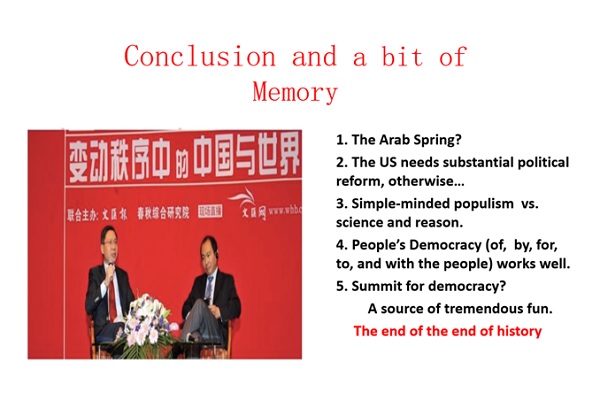
張維為與福山對談
福山表示中國需要政治改革,需要一人一票選舉。我説中美都需要政治改革,但是就我對美國體制的研究而言,美國需要更多和更實質性的改革,因為美國的體制是前工業革命時代的產物。在抗擊新冠疫情的過程中,我們看到了美國在聯邦政府和州政府層面分工迄今還不明確,這對於現代社會來説是一個大問題。
我還提到低智商的民粹主義可能會在美國盛行。當時福山很自信地説,這不大可能在美國發生,因為美國是成熟的民主國家,有言論自由、媒體自由,我説你有點天真了。
中國踐行的是人民民主,換言之,從“民有、民治、民享、民策、民依”這五個方面來看,我認為中國的人民民主制度比美國民主制度要好得多。這讓我想到了今年初美國國會遭到佔領時,一條傳播很廣的推文:“如果美國看到美國國會山發生的騷亂;美國會入侵美國,將美國從美國的暴政中解救出來”;還有一條推文是:“這是唯一一場在美洲發生的沒有沒有美國大使館參與的政變”。這些推文也在中國社交媒體上迅速走紅。
我想對中國人,尤其是對年輕一代而言,美國民主已經成為了笑話,而台灣的民主則是一個更大的笑話。這次美國舉行民主峯會,會成為中國互聯網上調侃和挖苦的對象,會成為中國年輕人的快樂源泉之一。
我在十年前跟福山辯論時就説過,就政治體制而言,中國的視野已經越過了美國模式。做一個可能不太恰當的類比,美國的民主峯會是一種過時的老式遊戲。“自由之家”組織衡量各國的所謂民主狀況,哪些國家進步了,哪些國家倒退了等等。美國就像生活在彩色膠片時代,經歷着富士和柯達之間的激烈競爭,而相比之下中國模式則適用於數字時代,我們放眼未來。
如果一些國家傾向於西方民主模式、傾向於美國民主模式,我們尊重你們的選擇,但是我們一點都不羨慕,我們倒是感到同情。西方模式必須進行改革,否則只會江河日下。所以我們看到的不是“歷史的終結“,而是“歷史的終結”的終結。這是我當時給福山的忠告,這個忠告現在依然成立。
謝謝大家!
(翻譯:程澤笠、湯卓筠,校對:由冠羣、沈玉萌)
Zhang Weiwei:
Thank you, Wang Guan. And thank you for the press corp for coming to this fascinating discussion on the issue of democracy. So, I will make a short presentation with my PowerPoints. My topic is “Democracy: China versus United States”. As we all know, democracy is controversial in many ways. If you ask Americans whether China is democracy, many of them will say “No, it’s autocracy”. If you ask Chinese, most Chinese today will tell you: “America’s democracy? No, it’s a Moneytocracy.
“Money determines everything”. So, whether given this kind of controversy, we can have a kind of a meaningful intellectual discussion on the issue of democracy. I’m thinking of whether we can use a kind of working definition. I’d like to quote, the famous line from Abraham Lincoln “Government of the people, by the people, for the people.” And, then I tried to compare China and United States, item by item, to see which democracy is the genuine democracy, which democracy is better.
Now, interestingly, we have just received this fascinating result, conducted by Dalia Research concerning the issue of democracy. In case of China, 13 % people surveyed say their government serves a minority. In other words, more than 80 % believe their government works for vast majority of Chinese population. In the United States, 52 % say their government serves a minority. Most people, more than half, believe their government serves minority.
And then, this is the study by Dr. Zhong Nanshan, very famous in China. He said, just a few days ago, if you live in China today, in terms of freedom from contracting the COVID-19 or from the COVID-related deaths, China today is at least 606 times safer and freer from COVID-related deaths and 1,678 times safer from contracting the disease. The calculation is very simple. If you look at the figure for the death toll of the COVID-19. United States is roughly 170 times of China’sin terms of absolute figure, and the China’s population is 4.2 times that of United States. So Chinese more than 600 times safer and freer from death relating to COVID-19.
And then look at this median net household assets. Indeed, you know, four decades ago, China was way behind the United States in terms of the personal well-being, wealth, et cetera. But today we can make a very interesting comparison. This is about net household assets. There are two columns for the average family level. In that case, the United States is higher than the China.
But at the median level, the figure is totally different. If you look at the United States in 2019, it’s closer to one thousand USD per household at the median level. So, in Chinese yuan, it’s close to seven thousand. Now, in the case of China, it’s slightly more than double that of the United States. Of course, the figure I used is for urban households. We don’t have figures for rural families, so far, we haven’t got that statistics yet. Hopefully, by next year we’re going to have one and we can make comparisons. BIf you look at the rising living standard in the countryside, it’s also rising faster than we expected.
And then, of course, this famous Pew survey, which you can check back 5 years ago, 10 years ago and today. So, in that case, 91 % Chinese surveyed believe China is on the right track, 41 % believe the United States is on the right track. For the UK, I’m sorry, 21 %, for France, 20 %. There must be a lot of violation of human rights in these countries given so many people are not happy with direction of their country. So, these are figures, survey conducted by reputable international institutions. So, I’ll say with certainty, concerning “for the people”. The Chinese model, Chinese political system or Chinese democracy have delivered and much, much better than the US model.
Consider the “of the people”, I just give you one figure, 90% of Chinese civil servants come to form ordinary background, if you look at remake by Joseph Stiglitz said that, “The US is noew of the 1%, by the 1%, for the 1%.” As most people read this country, most of them are for the rich.
And then, “by the people”, that’s where most controversy occurs. In the western political discourse today. Indeed, multi-party system, universal suffrage, itself would mean “government by people”. Yet, from Chinese point of view, this is, as Eric just mentioned, it’s about institutional procedures, and saidthat it is the bestprocedures ofdemocracy.Procedures and the substance, may be same, may be very different.
So the Chinese approach is always first focus on explore substance. And then, procedures will take shape. We have a traditional philosophy since ancient time, it’s called the “Dao” and the “Shu”. “Dao” means overall objective, overall purpose, overall principles that govern“Shu”, govern procedures. That’s also one way why China can carry out reforms while many so-called liberal democracies cannot. Because they are very rigid with procedures.
And then if you look at the substantial democracy, the Chinese approach can be called “to ensure good governance for the people”. That’s very important. So I submit this thesis a long time ago, I think 15 or 20 years ago, I said we need to have a paradigm shift, a shift from what’s called the “democracy versus autocracy” and “democracy”, “autocracy” are defined by the West and the West only, to “good governance versus bad governance”. What’s substantial democracy? It means to ensure and achieve good governance as its primary objective. And China has been doing that and rather successful.
Again, if you look at the same research from Dalia Research, interesting, it’s the issue of so-called democracy deficits. In the case of China, 84 % people surveyed think democracy is important, 73 % view their country, China, as democracy. So, the democracy deficit 11 %. In the United States, 73% think democracy is important and 49% view their country as democracy. So, democracy deficit is 24 %. And this is done by Dalia Research commissioned by ex-prime minister of Denmark, Mr. Rasmussen, and he is of course as you all know, quite hostile to the Chinese political system. So that result shows a lot about how “by the people” had not been really achieved even in the eyes of most Americans.
Then that is more interesting. It’s again a study by PEW survey. Very few in anypublic survey think American democracy is a good example for other countries to follow. This is a study of major countries, about 20 or so. And 57% said US democracy used to be a good example, but has not been in recent years. And slightly, surprisingly, 72 % Americans don’t think that US is a good model of democracy for other countries. I think, just as professor Martin Jacques mentioned, United States must need a lot of courage, you know, as if nothing has happened, without this storming of the Congress, theCapitol hill, and things are as usual. Actually, even within the United States, many people are thinking of the problems with democracy.
If this summit were to be held, seems it will be held. I hope the number one item or the topic will be, (just as)a few years ago, the Economist have a cover story, it’s called “What’s Gone Wrong With Democracy?” And which quotes me as Professor Zhang Weiwei claims: “US democracy is deeply flawed. Itelects second-rate leaders”. Actually, my original remark was “it produces third-rate leaders”. Unfortunately, that happened.
And “by the people” the Chinese way, I would describe the Chinese Communist Party as a “holistic interest” party. It differs tremendously from the Western political parties, I would call them “partial interest” parties. And this “holistic interest” party actually is a part of China’s own tradition. China was first unified in 221 BC.
China is a civilizational state, in the sense that it’s an amalgamation of hundreds of states into one, over its long history. So, since China’s first unification in 221 BC, China has been practicing what we may call a unified ruling entity. Otherwise, the country became ungovernable and broken apart. China practiced American model of democracy after the Republican Revolution in 1911, and then the country degenerated into civil wars and fighting between warlords, each warlordsupported by certain western powers. So, this is indeed a common sense in Chinese political culture, governing a country of amalgamation of hundreds of states into one, you follow this principle of a unified ruling entity. If you prefer, China being on the oneparty system for more than 2,000 years, yeah. So, the Communist Party is a continuation,evolution,and development of that tradition. Otherwise, it will have problems of country’s disintegration.
Now behind this, again, since China’s long tradition of meritocracy. China invented Public Civil Servant Examination System, the “Ke Ju System”. So today the way China elected leaders is a system, which I call “Selection+Election”, if the US model is about “Election”. Which model is better? I would say, you know, Chinese model slightly better, if not much better, because we elect competent leaders.
If you look at the members of the political bureau, especially standing committee, most of them have already governed over 100 million people before they came to their present positions. It’s vigorous process, selecting competent leaders. Most of them work twice as number one of Chinese province as party secretay or governor, et cetera.
So arguably, the Chinese leadership today is the most competent in the world. And then, it’s about competence, it’s about ability for reform. You know, in order to carry out reforms, I think you need to have a “holistic interest” party. Why? In so many liberal democracies, there are no way to reform. Whoever makes reform will step down, you know. The point is that you need to overcome vested interests. Only a political institution, political force, which can represent the vast majority, holistic interest of your people, you can push for reform, and China is the expert on reforms, we are conducting reforms every day, every month, every year. And I think it’s time for the West to think hard on how to reform its political system, otherwise, the system will go way down. And also, because you are a holistic institution, you can plan for the future for next year, next 5 years, next 10 years, next 100 years, for next generation. That’s definitely advantage of Chinese political system.
Now, having said “of the people, by the people, for the people”, now I draw something from Chinese experience, which Abraham Lincoln did not know much about. I call it “to the people” and “with the people”. Now let’s discuss “to the people”. It’s mainly about decision-making process. If you compare the quality of decision-making between China (and) United States, I would say Chinese decision quality is much better, because we practice this democratic centralism, which we borrowed from Soviet Union, but reinvented, according to Chinese practice.
Like, for example, how China makes its 5-year plan. Roughly, it takes 1 year and a half in the making. In the process, you have hundreds of rounds of consultations, with think tanks, with experts, with general public, within the party, outside the party. And then if you look at this, what we call whole-process democracy, not only you produce a plan, but also you have the review of the implementation of the plan, and in the end, the execution of the plan.
Many of you are here for many years. We have, for instance,“Liang Hui”, the two sessions in March and then we review the 5-year plan and annual plan. And then, at the end of the year, usually in December or November, we have the CPC Central Committee Conference on Economic Affairs, again we reviewed that. And in each and every “Liang Hui”, Chinese prime minister and his work report exactly tell you a to-do list to what extent we have finished that and we have not finished that. It’s very earnest. You compare the quality of the work report of Chinese government and the State of the Union Address of the American presidency. The Chinese quality is much, much higher. Each line and every line relates to people’s daily life and people appreciate that.
And for the United States, just now, Kishore mentioned this case, a study by Martin Gillen and Benjamin Page, basically the wealthy few move policy, while the average America has little power, after their reviewing answers to 1779 survey questions asked between 1981 and 2002. So, I think it’s a matter of, not just electing a leader every 4 years, it is about decision-making process, to what extent your decision reflect the will of the people. So that’s “to the people”. We adopt principle of “from the people, to the people” one round, “to the people, from the people” another round. So, we go several rounds of consultation democracy, then reach mature decision.
I always joke with my British friends. I said why bothering with the referendum, it’s very old-fashioned. If you compare this with smartphones, it’s like 2G, you know. We are now in the age of 5G. We are to really move with changing times, only 3 %, some difference, the country becomes divided and becomes a huge problem. If adoptting a consultative democracy, and democratic centralism, I can assure you with the Chinese model, even with 30 % difference, we can reach consensus and move the nation forward.
Lastly, “with the people” that’s famous line from Xi Jinping, we should stay forever with the people. That’s we mean it, it’s not just words, it’s practice. Each party leader, political bureau member, has what’s called “contact points” with different parts of the country, provinces. You go there regularly, you review their situation, et cetera.
At the end of the day, i we have to ensure a balance between political power, social power and power of the capital, to ensure that this balance of the three powers will be in favor of the vast majority of the population. Otherwise, the system will be in trouble. From my point of view, in the United States, it is a balance of the three powers in favor of the super rich. I’ve got one line to say, difference between Chinese political system and American political system. The Chinese system is very clear, the richest 100 individuals cannot dictate the Political Bureau. In the United States, the 100 rich individuals most likely can dictate the White House or even less than 100 individuals.
As a result, you have all the problems, you know. So, I think United States system needs serious reforms. I’m thinking of this example. You know I really feel deeply upset. The United States spent $2.3 trillion on the Afghan war. It’s killing, destruction, gross violation of human rights. $2.3 trillion, in the past 20 years. In the case of China, since General Secretary Xi Jinping came to power, we eradicated the last batch of poverty, extreme poverty, closer to 100 million people.
We spent $250 billion. So, it’s roughly 10 times less money than US spend on Afghan war. We completely finished this task of ending poverty. Why the United States could not use the $2.3 trillion on ending the poverty in the United States? Indeed, with this money, again, in theory, a hypothesis, with Chinese model adapted to different situations, we can wipe out global policy, in theory, at least. But this money, huge amount, spent on war, on destruction, on killing, on violation of human rights.
Why so? One interpretation which many peopleknows, actually, the media should expose that, the interest, vast interest of the military industrial complex as already mentioned in 1950s by President Eisenhower. So, the enimy of the United States is not Russia, not China, but the United States itself. Same with the West, the enimy of the West, not China, Russia, or other country, but the West itself. The end of democracy is the particular system of democracy as it is practiced now.
Lastly, my conclusion and a bit of memory. Just now Wang Guan mentioned my debate with professor Fukuyama exactly 10 years ago, in June 2011. It almost coincided with this Arab Spring, and Mubarak was toppled. And he said in this debate, China may also have a kind of Arab Spring and I said no chance. And I made the forecast, I said, on the contrary, Arab Spring itself will become Arab Winter.
In the end, it became Arab Winter, most people agreed today. And then he said China needs a political reform for multi-party system, one person one vote. I said both China and United States need political reforms, but from my study of the American political system, the US political model, I insisted, needs more reform, substantial reforms. Why? I said because your system is a product of the pre-industrial era. From this process of fighting COVID-19, we saw there is no clear responsibility, division of labor between the federal government and states government.
That’s a huge problem for modern society. And then I also said simple-minded populism may eventually prevail in the United States. And Fukuyama was confident it will not happen in American society, and because it’s a mature democracy with free media, free press. I said you are slightly a bit naive.
And well, on all this, I would say, you know, China has practiced people’s democracy. In other words, “of the people, by the people, for the people, to the people, with the people” on all five fronts. In my humble view, the Chinese model and system works better and much better than the American system. For this summit for democracy, I am pretty sure that as a media people, I assume you can feel the power of the Chinese providing, we wish to report or not. Indeed, I can assume that is a source of tremendous joy for many Chinese, especially the younger generation.
It reminds me about the famous tweet, when this storming of the capitol hill occurred “If United States saw what has happened on the capitol hill, the United States would invade the United States, to liberate the United States from the tyranny of the United States” or another tweet, you know, “that’s the first quote that took place in Americas without the participation of the US embassy” these kinds of tweets will go around in Chinese internet, social media. I’m pretty sure about that. Because indeed, for especially Chinese young generation, American democracy is increasingly a joke. As for Taiwan’s democracy, it’s a greater joke.
And Now, from my study of the political system, actually, my debate with professor Fukuyama, I said this already, 10 years ago, as in the political system, Chinese vision is already way beyond the American model. Maybe I can draw an analogy, which may not be very appropriate.
This kind of summit for democracy is a kind of old game. Where freedom house will measure, which countries is making progress, which countries moving backwards et cetera. It’s almost like the competition, in the color film industry, between Fuji and Kodak. In that era,they compete fiercely with each other. But the Chinese model is more or less for the digital age. So we are really looking beyond, moving beyond, we are not bothered with that.
If many countries, people in the world prefer the western model, Americans prefer the American model. We respect your choice, but we do not envy you. To be honest, people like us and Eric, we have some sympathy for you. You have to improve otherwise, without reform, it will be going way down. So, it’s not “the end of history”, it’s the end of “the end of history”. That’s all the remark I offered to professor Fukuyama 10 years ago. So, my conclusion remains valid. Thank you very much!
本文系觀察者網獨家稿件,文章內容純屬作者個人觀點,不代表平台觀點,未經授權,不得轉載,否則將追究法律責任。關注觀察者網微信guanchacn,每日閲讀趣味文章。