蓋爾·拉夫特:沒有單一貨幣可以取代美元,但我們正邁向貨幣多極化時代
【採訪/觀察者網 劉倩藜 翻譯/寧櫟】
美元自擲核彈?
觀察者網:美國與歐洲盟友共同向俄羅斯投擲“金融核武器”,決定將多家俄羅斯銀行從SWIFT(環球銀行金融電信協會)支付系統中剔除。SWIFT系統由美國等西方國家建立,但如今對俄實施SWIFT禁令,這反而是在削弱自己建立的國際體系。這對全球經濟和金融秩序會造成什麼影響嗎?
**蓋爾·拉夫特:**2019年夏天,我出版了一本書《去美元化:反抗美元和新的金融世界秩序的崛起》。這本書中預測了今天發生的許多事件,但我必須説,情況變化速度之快令我非常驚訝。實際上,我們正在見證二戰後由西方國家在“佈雷頓森林會議”上主導建立的國際貨幣體系所發生的轉變。在過去的幾周裏,美國及其盟友幾次“破戒”:把一個主要經濟體踢出SWIFT;未經法律程序,沒收他們稱之為“俄國寡頭”的私人資產;最糟糕的是,他們凍結了俄央行外匯儲備。
這實際上是西方在過去8個月裏第二次染指別國央行儲備。前一次是在去年夏天,美國凍結了阿富汗央行數十億美元資產。在“經濟戰”中,凍結別國央行資產是由國家支持的海盜行為,相當於在軍事衝突中使用核彈。
同時,這也是一種自我毀滅的行為,因為這將破壞其它各國央行對美元體系和基於美國規則的國際秩序的信任。美國想自己制定規則、執行規則,凡是不服從美國號令的國家都會面臨和俄羅斯一樣的處境。這是對許多國家敲響的一記警鐘。目前,放眼全球,每十個國家當中就有一個遭受到美國某種形式的制裁。
毫無疑問,過去一個月的事件標誌着全球金融史上的轉折時刻,將成為經濟學史上最糟糕的自毀傷口被記錄。美元作為儲備貨幣是美國在世界上的重要權力,這讓美國能維持鉅額赤字,維持30萬億美元的債務。
歷史上有許多儲備貨幣,平均維持了80到100年。美元作為儲備貨幣也快到這個年限了。如果美元也重複這種歷史命運,那就是因為美國政府到處發動經濟制裁和懲罰,而不顧累積的負面後果。
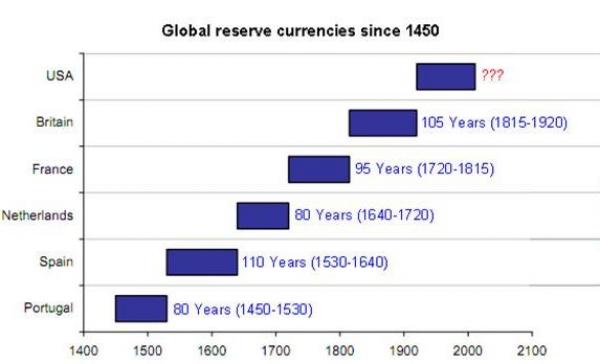
1450年來全球儲備貨幣(葡、西、荷、法、英、美元)的有效年限(來源:geab.eu)
觀察者網:美國聯邦政府債務總額超過了30萬億美元,大大超過了去年約23萬億美元的美國國內生產總值。美國勢必將面臨更高的債務壓力。聯邦政府是否可能扭轉債務的持續上漲?如果不能,這會否觸發更大的債務違約危機甚至是全球金融風險?
**蓋爾·拉夫特:**如果要縮小如此鉅額的債務,以下兩項中至少做到一項。要不通過推動經濟增長和加税來增加財政收入;要不減少開支,比如削減國防預算。理想情況下,應該採取靈活的政策組合。但目前看來,拜登政府既沒有意願也沒有能力做到上述任何一項。
美國中期選舉在即,且全國面臨通脹壓力,此時如果增税無疑是“政治性自殺”。拜登正在考慮向富人徵税,但這會是一場艱難的硬仗,尤其當下已有美國資本外逃到世界各地的避税天堂。新冠疫情以來,美國開動印鈔機,通過多項經濟刺激計劃向經濟“大注水”,而美國零利率水平已維持近15年之久,美聯儲的“工具箱”已經耗盡。
如果減少政府開支呢?這同樣不可能。事實上,隨着每天有一萬名“嬰兒潮時期”(1946-1964年)出生的人退休,政府支出只會增加。而拜登政府2023年國防預算增加了790億美元,僅增長部分就多過俄羅斯全國軍費開支。
由於美國政府層面不願採取任何果斷行動來削減赤字,債務還將繼續膨脹。隨着利率不斷上升,債務利息成本可能在十年後成為美國政府的第一大支出,比國防預算還大。持有美債的國家看着這種“奇觀”,驚恐地問“結果會怎樣?美國最終還能還清債務嗎?還是説它才是所有‘債務陷阱’的始作俑者?”我認為這將影響各國央行是否繼續持有美債的決策。
觀察者網:據美媒近日報道,沙特阿拉伯正考慮向中國出售石油時使用人民幣而不是美元結算。而據印度媒體報道,莫迪政府最近批准了俄方的一項提議,允許俄實體投資印度公司債券。在西方國家對俄進行制裁的情況下,這一機制能使印俄貿易繼續進行。這些能否看作對美元和美國金融霸權的反抗?如果説,一個新的世界金融秩序正在崛起,是否為時尚早?
**蓋爾·拉夫特:**毫無疑問,一場針對美元霸權的全面反擊戰正在發生。很多人會問:如果美元不再是儲備貨幣,那麼誰將取代它?歐元?人民幣?但這個思路錯了。這不是舊皇帝下台、新皇帝登基的邏輯。沒有單一貨幣可以取代美元。但是,我們正從貨幣單極化的時代轉向貨幣多極化的時代。
在這個時代,包括黃金和加密貨幣在內的多種貨幣將相互競爭,以期在各大央行儲備中佔據更大的份額。在新的金融秩序中,越來越多的國家將以非美元貨幣進行交易。美元對價值數萬億美元的大宗商品市場將失去掌控力,而世界對美元的需求也將下降。
一旦對美元的需求減少,美國將無法像近一個世紀以來那樣輕鬆地出售以美元計價的債務工具。像中國這樣的國家將重新考慮以之前的力度購買美債是否明智。
隨着對美債的需求不斷下降,美國將不得不提高其債券的利率,這意味着償債成本將飆升,而留給國防、醫療、教育、基礎設施等的資金會更少。
同時,這將影響美國提供對外援助、支持國際組織、保護其盟友以及在海外投資基礎設施的能力。因此,越來越多的國家將對美國感到失望,並將尋求其它安全和經濟夥伴。
在美國國內,由於用於社會服務的資金越來越少,民眾會變得更加不滿,這可能導致政治體系更加不穩定。
謊言帝國
觀察者網:3月24日,拜登連續出席了北約峯會、七國集團峯會和歐盟峯會。面對當前俄烏衝突造成的人道主義危機和近期全球能源價格飆升,美歐仍表示將繼續對俄國施壓,並向烏克蘭提供軍事支持。看來,這次聚會不是為了 “滅火”,也不是為了和平,而是希望戰爭能夠延長。作為美國能源安全理事會****的高級顧問,您認為在能源安全和全球能源格局的角度,美國的用意是什麼?
**蓋爾·拉夫特:**當特朗普擔任總統時,他創造了“美國能源主導地位”的説法,要求增加北美石油和天然氣的生產,並利用這些作為外交政策的工具,取代歐佩克和俄國對美國及其盟國的影響。
拜登更傾向於環保運動,他沒用這個説法,但他的意圖和特朗普相似,他想把中東和俄國邊緣化,因為中東不再是美國全球利益的重心。俄烏衝突是美國讓歐洲受制於北美能源的一條捷徑。
歐盟是一個經濟上被削弱的官僚機構,由一羣越來越脱離人民需求的政治精英統治。美國已經意識到在經濟上接管歐洲的時機已經成熟,美國所要做的就是讓歐洲與俄國能源切斷聯繫。這就解釋了美國政客們對北溪2號(譯註:俄羅斯通往歐洲的新建天然氣管道)的執着。
在美國參議院,拜登的所有提案一度被擱置,直到拜登提出制裁北溪2號。為什麼美國對一條管道如此執着?答案是:這條管道阻礙了美國成為歐洲主要能源供應商。一旦美國接管了歐洲的能源供應,歐洲將成為美國的附庸,配合美國對付下一個目標:中國。
一旦歐洲對美國天然氣形成依賴,它將付出高昂代價。比起俄國管道運來的天然氣,美國液化天然氣貴很多,一旦歐洲能源價格變高,歐洲的製造成本和生活成本都將受到負面影響。可悲的是,歐洲人並不能看到這一切,當他們看到時,已經太晚了。
觀察者網:俄烏危機在一定程度上造成了能源價格的暴漲,歐洲天然氣期貨價格一度逼近3900美元/千立方米。8年前,中國和俄國簽署了為期30年的天然氣供應協議,價格是350美元/千立方米。目前,面對歐洲油氣價格的飆升和全球通脹的壓力,美國和歐洲在剛剛結束的北約峯會上宣佈,將繼續對俄國施加壓力,並向烏克蘭提供軍事支持。隨着戰爭拖長,烏克蘭人民將不是歐洲唯一的受害者。對歐洲來説,美國真的是一個可靠和值得信賴的盟友嗎?
**蓋爾·拉夫特:**基辛格曾説:“美國沒有永久的朋友或敵人,只有利益”。我認為這是判斷美歐關係的一個好方法。許多政治家説,這種關係的基礎是 “共同的價值觀”,這通常是正確的,但真正使跨大西洋聯盟保持完整的是共同利益。
對美國來説,一個弱小的歐洲是巨大戰略機遇,使美國能夠為美國公司獲得許多經濟利益,並建立一個經濟和軍事上強大的西方聯盟,以後可以把它擴大到印太區域。作為這個廣泛聯盟的領導者,在俄羅斯被削弱的情況下,美國能把目光轉向其頭號戰略競爭對手——中國,建立對太平洋地區的永久統治。
但從長遠來看,這個聯盟可能會成為美國的負擔。歐洲的經濟正在迅速衰退,面臨沉重的債務、緩慢的經濟增長、不斷上升的失業率和數以百萬計的難民……美國面臨的潛在危險在於,如果歐洲在其內部壓力下遭遇崩潰,美國將不得不投入更多的資源來維持歐洲,歐洲可能從美國“資產”變成美國“債務”。
觀察者網:還記得美國舉行所謂“民主峯會”前,您在中國的一場公開演講中説:“一個多世紀以來,促進民主一直是美國外交政策的一部分”。您在推特上提到,最近美國又冒出一個新詞:先進的工業民主國家,用來描述“西方+精英俱樂部”,各種Buff疊滿。您生動地點評説:印度,你還不夠民主;土耳其,你還不夠工業化,你們必須夠“先進”才能進入這個精英俱樂部。多年來,制定規則是美國自賦的特權。隨着美國“選邊站”的遊戲不斷擴大,您認為這個遊戲還會有更多參與者嗎?理由是什麼?
**蓋爾·拉夫特:**世界被劃分為三組國家。第一組是“西方+精英俱樂部成員”,如日本、新加坡和韓國。第二組是以中國和俄國為首的所謂“修正主義國家”,這些國家希望推動建立一個更加公平的國際體系,使其他國家不再生活在西方的支配之下。第三組是大多數國家的狀態:不結盟。不結盟國家從全球化體系中獲益最多,它們希望在全球化體系中不受大國壓力,可以自由和各國進行貿易,自由使用貨幣或者技術。
俄烏衝突使這三個羣體之間的界限更加清晰。在近200個國家中,約有100個國家屬於不結盟陣營,而其他100個國家則被夾在西方和所謂“修正主義國家”之間。這或多或少是全球權力分佈的新架構。未來幾年將是兩個陣營之間的對抗,不結盟國家越來越多地被擠壓在中間,就像一塊奶酪夾在兩片面包之間。
對我來説,印度是最值得關注的國家,不僅因為它正在成為人口最多的國家,還因為它也是世界上最大的民主國家,但它似乎並不想與西方結盟。印度對俄烏衝突的態度讓美國震驚,美國曾以為印度是囊中之物。
最近幾周的事態表明,印度不僅不想譴責和制裁俄羅斯,而且實際上已積極行動來破壞制裁,這將決定美國的印太計劃能否依靠印度?印度能否成為新的不結盟運動的關鍵?它是否能與中國、俄國以及可能的巴西建立一個由金磚國家領導的更大的“修正主義”集團?
A bomb for itself?
Guancha: The US reached an agreement with major European allies to remove several Russian banks from the SWIFT system, in what has been called “financial nuclear bomb-level” sanctions. The SWIFT system was created by the United States, but the widening sanctions upon Russia shows that Europe and the United States are weakening the international system established by themselves. What impact will this have on the global economic and financial order?
Dr. Gal Luft: In summer of 2019 I published a book called “De-dollarization: The Revolt Against the Dollar and the Rise of a New Financial World Order.” Many of the events that are happening today were predicted in the book, but I must say that even I am quite amazed by the speed of the change. We are literally witnessing a transformation of the global financial system heralded by the western powers after the Second World War at the Bretton Woods conference. Over the past several weeks, the US and its allies have broken several taboos: They disconnected a major economy from SWIFT; they seized private assets of Russian nationals they call oligarchs without any legal proceedings, and, worst of all, they froze central bank reserves. This was actually the second time in eight months Washington laid its hands on central bank reserves. The first time was last summer when the US froze billions of dollars of the Afghan Central Bank. Freezing central bank assets in economic warfare is an act of state-sponsored piracy and the equivalent of using nuclear bomb in a military conflict. But it is also a self-defeating act which is only going to undermine the trust central bankers around the world have in the US dollar system and America’s rules-based international order. Since America wants to write the rules and enforce them, every country that does not accept Washington’s dictates could find itself in the same situation as Russia. This is a wake-up call to many countries. As it is, one in ten countries on the globe is under US sanctions. I have no doubt the events of the past month mark a watershed moment in the history of global finance, one that will go down in history as the worst self-inflicted wound in the history of economics. The dollar’s status as reserve currency is what gives America its power on the world stage, and it is what allows the US to run trillion-dollar deficits and pile $30 trillion in debt. Throughout history there have been a number of reserve currencies. The average lifespan of them has been 80-100 years. The dollar has been a reserve currency for roughly the same period of time. If it has run its course this is only because of the actions of the US government which has been trigger happy in applying sanctions and other economic punitive measures without seeing their cumulative impact.
Guancha: The total US federal government debt has exceeded 30 trillion, which has greatly exceeded the US GDP of about 23 trillion US dollars last year. We will see the interest payments on the national debt gradually rise. Is it possible for the federal government to reverse the continuing rise in debt? If not, will this trigger even stronger debt default crisis even global financial risks?
Dr. Gal Luft: In order to shrink the such a huge debt one of two things must happen: either the government increases its revenues through robust economic growth and increased taxation or the it reduces its expenditures, for example by cutting the defense budget. Ideally it would be some combination of the two. However, it does not look like the Biden administration has the power or will to do either of those. Ahead of the midterm elections and with rising inflation, raising taxes is a political suicide. Biden is talking about taxing the rich, but it would be an uphill battle with risk of capital flight from the US to various tax havens. After pouring trillions of dollars into the economy in various Covid recovery programs and after keeping interest rates at near zero for nearly a decade and a half, the Fed is running out of tools to stimulate the economy. As for reducing government expenditures this is equally unlikely. In fact, with 10,000 baby boomers retiring daily the expenditures only seem to grow. Biden’s defense budget for 2023 reflects an increase of $79 billion which is bigger than the entire military spending of Russia. With the political class unwilling to take any painful step in the direction of cutting the deficit, the debt will continue to balloon, and with rising interest rates the cost of servicing the debt could become by the end of the decade the number one expenditure of the US government – bigger than the defense budget. Countries buying US bonds watch this spectacle with horror and asking themselves “where does it all lead to?” Can the US ever pay back such debt or is it the mother of all debt-traps? I think this will shape central banks’ decisions on how much US debt to continue to hold.
Guancha: Saudi Arabia is considering using yuan instead of U.S. dollars in oil sales to China, according to recent reports from U.S. media. According to Indian media reports, the Modi government recently approved a Russian proposal to allow Russian entities to invest in Indian company bonds. In the context of financial sanctions against Russia by Western countries, this mechanism can enable India-Russia trade to continue. Could all these be regarded as a revolt against the dollar and US financial hegemony? Is it too early to say that this is the rise of a new world financial order?
Dr. Gal Luft: There is no doubt that a full-blown revolt is already taking place against the dollar hegemony. Many people are asking: if the dollar is no longer reserve currency what will replace it? The Euro? The yuan? This is the wrong framework to look at the issue. It is not the case of one king succeeding another. There is no single currency that can replace the dollar. Instead, we are moving from an era of currency unipolarity to an era of currency multi-polarity in which several currencies, including gold and cryptocurrencies, will compete against each other for greater share in central banks’ reserves. In the new financial order countries will increasingly transact with each other in non-dollar currencies. The dollar will gradually lose its grip over the multi-trillion-dollar commodity market and the demand for the US currency will fall. Once there is less demand for dollars, the US will not be able to sell its dollar denominated debt instruments with the same ease it has done for nearly a century. Countries like China will reconsider the wisdom of buying US debt in the same pace as before. With demand for its debt declining the US will have to raise interest rates on its bonds and this means that the cost of servicing its debt will spike, leaving less money for defense, health, education, infrastructure etc. This will affect US ability to provide foreign aid, support international organizations, protect its allies and invest in infrastructure projects abroad. As a result, more and more countries will become disappointed by the US and will seek alternative security and economic partners. Domestically, as less and less money directed to social services, the public will become increasingly unhappy and this could lead to an even more unstable political system.
Empire of Lies
Guancha: On March 24, Biden attended three Summits in a row, the NATO summit, G7 summit and EU summit. In the face of the humanitarian crisis caused by the current Russian-Ukrainian conflict and the recent soaring energy prices across the globe, the US and Europe still expressed that they would continue to exert pressure on Russia and provide military support to Ukraine. It seems that the get-together is not for “putting out the fire” or for peace, but wishing that the war cycle could be prolonged. As a senior advisor to the U.S. Energy Security Council, what do you think the U.S. considerations are from the perspective of energy security and the global energy landscape?
Dr. Gal Luft: When Donald Trump was president, he coined the term “American Energy Dominance” which essentially called for increased production of north American oil and gas and using these energy resources as tools of foreign policy to supplant the influence of OPEC and Russia on the America and its allies. Biden, who is much more beholden to the environmental movement, has refrained from using this term, but his intentions are similar in the sense that like Trump he wants to marginalize the Middle East, which is no longer a top priority for US global interests, as well as Russia. The war in Ukraine is a convenient way for the US to make Europe beholden to North American energy. Europe is an economically weakened bureaucratic mess ruled by a political elite increasingly divorced with the needs of its people. The US has realized Europe is ripe for economic takeover. All it has to do is to disconnect Europe from Russian energy. This explains the obsession of US politicians with Nord Stream 2 pipeline. At some point all of Biden’s nominations were put on hold in the Senate until Biden sanctions the pipeline. Why was America so obsessed about a single pipeline? The answer is that the pipeline stood in America’s way of becoming the main energy supplier to Europe. Once the US takes over European energy supply Europe will become a vassal of America in its pursuit of its next objective to take on China. Europe’s dependency on America’s gas will come at a very steep price. LNG will always be more expensive than Russian piped gas and this means that European energy prices will now become much higher with negative implications for European manufacturing and cost of living. Sadly, Europeans are not able to see any of this, and when they do, it will have been too late.
Guancha: The outbreak of the Russian-Ukrainian crisis has caused energy prices to skyrocket to some extent, and the European natural gas futures price once approached $3,900/thousand cubic meters. Eight years ago, China and Russia signed a 30-year natural gas supply agreement, which cost only $350 per 1,000 cubic meters of natural gas. At present, in the face of soaring oil and gas prices in Europe and the pressure of global inflation, the US and Europe announced at the just-concluded NATO summit that they would continue to exert pressure on Russia and provide military support to Ukraine. As the war prolongs, people in Ukraine will not be the only one in Europe to suffer. To Europe, is American really a reliable and trustworthy ally?
Dr. Gal Luft: Henry Kissinger once said that “America has no permanent friends or enemies, only interests.” I think this is a good way to judge US-European relations. Many politicians say that the relations are grounded in “shared values,” which is generally true, but what really keeps the transatlantic alliance intact are shared interests. For America, a weak Europe is huge strategic opportunity, allowing Washington to reap many economic benefits for its corporations and forge an economically and militarily powerful western alliance which it can later expand to include Indo-Pacific allies. As a leader of such a broad alliance and with a weakened Russia, the US will be able to shift it sights to its number one strategic competitor – China – and establish permanent domination over the Pacific region. But in the longer run this alliance could become a liability for America. Europe’s economy is declining rapidly, facing heavy debt, slow growth, rising unemployment, and waves of millions of refugees. The danger for the US is that if Europe collapses under its own weight the US will have to invest growing resources in keeping it afloat and Europe could turn from an asset into a liability.
Guancha: I still can recall what you said when addressing to a Chinese panel before the US’s Summit of Democracy, “promotion of democracy has been a fixture of US foreign policy for more than a century”. Recently you mentioned on your Twitter account: A new term born in the blob to describe the west+ honorary members: Advanced Industrial Democracy. You put it vividly as: India, you are not democratic enough. Turkey, you are not industrial enough. You must also be “advanced” to get in the elite club. Setting-rules is a self-claimed privilege of the US for many years. Will there be more followers in the game given the widening “Us and Them” game? Why or why not?
Dr. Gal Luft: The world is divided to three groups of countries. The first group is the west plus some honorary members like Japan, Singapore and South Korea. The second are the so-called revisionists led by China and Russia, who are unapologetically pushing for a more equitable international system in which the “rest” are no longer living under the dictates of the “west.” The third group are where most of the countries are – non-aligned. Non-aligned countries stand to benefit most from the globalized system and want it to survive without being subjected to great power pressures, without being told with whom they can trade, what currency they should use or what technology they should adopt. The Ukraine war has sharpened the lines between the three groups. Out of almost 200 countries about 100 are in the non-aligned camp while the other 100 are split in half between the west and the revisionists. This is more or less the new architecture of global power. The coming years will be an epic struggle between the two camps with the non-aligned countries becoming increasingly squeezed in the middle, like a piece of cheese caught between two slices of bread. To me, India is the most interesting country to watch, not only because it is on its way to become the most populated country but because it is also the world’s largest democracy yet it does not seem to be willing to align itself with the west. India’s approach to the war in Ukraine has shocked Washington, which had assumed that the Indians are in their pocket. The events of recent weeks, with India not only unwilling to condemn Russia and join the sanctions but actually taking active steps to undermine the sanctions, will determine whether or not the US can rely on India for its Indo-Pacific ambitions, whether India becomes the linchpin of a new non-aligned movement or whether it joins China, Russia and possibly Brazil in the creation of an even bigger revisionist bloc led by BRICS.
本文系觀察者網獨家稿件,文章內容純屬作者個人觀點,不代表平台觀點,未經授權,不得轉載,否則將追究法律責任。關注觀察者網微信guanchacn,每日閲讀趣味文章。