周波:是時候要求美國、北約和俄羅斯“不首先使用”核武器了
【文/觀察者網專欄作者 周波】
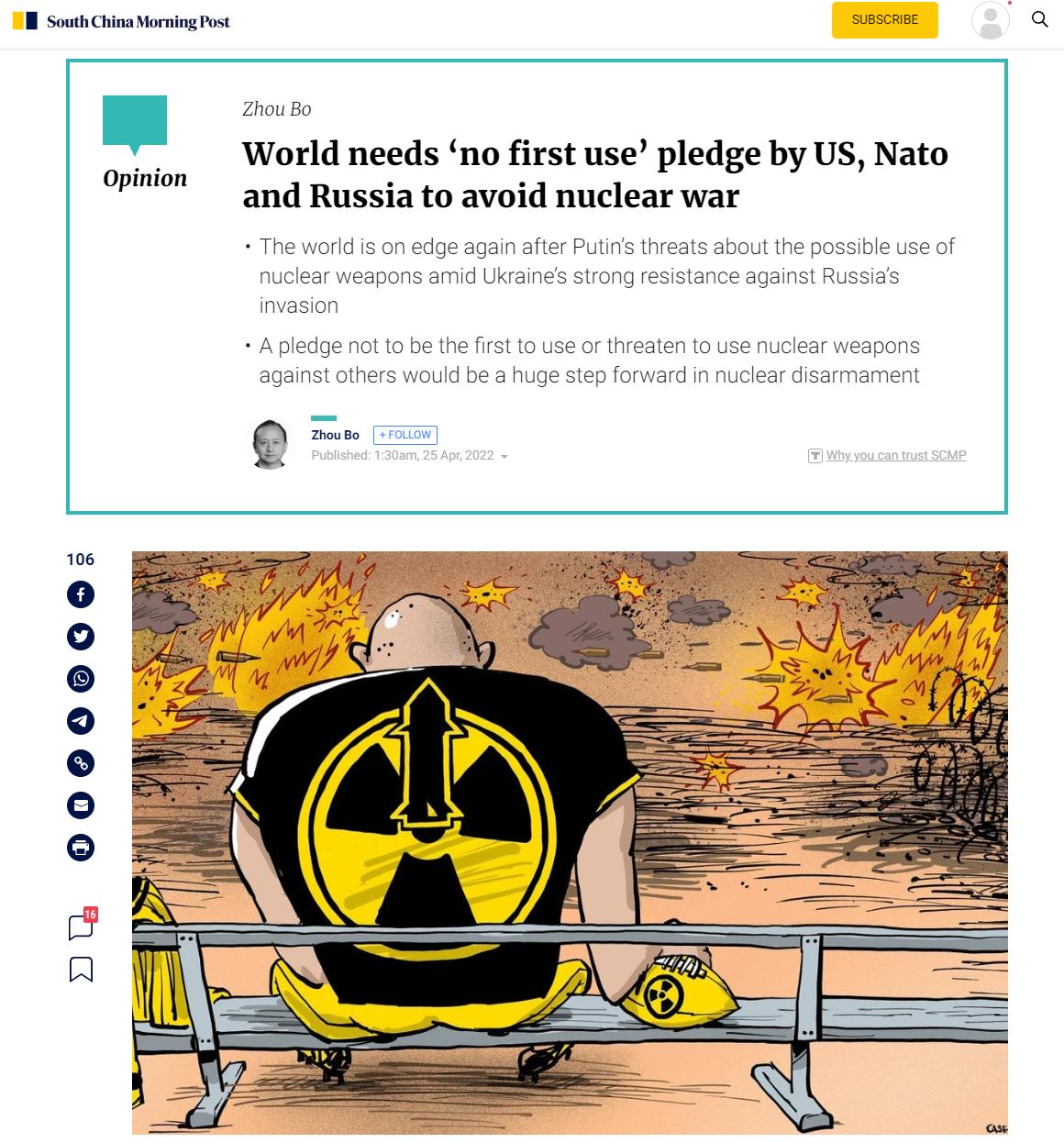
核武器的重要性又一次不言而喻。俄總統普京發出的核打擊重磅警告,讓人們感覺到現在討論核裁軍完全是徒勞的。可以想見,朝鮮是如何在為自己已經發展了核武器而慶幸。人們不禁猜測,下一個可能出現在亞洲或者中東地區的擁核國家究竟是哪一個。
我們正在踏入一個核叢林,在那裏,一枚枚核彈如低垂的果實,誘人地搖曳着。但是,如五個核大國在一月份的聯合聲明中所誓言的,“核戰爭不可能贏,也決不能打”,那麼一個現實可行的方法是,五個核大國保證不首先對對方使用或威脅使用核武器。
這對所有核大國來説都是可能的,因為這不會影響到它們的有效威懾力。 自1964年引爆核裝置以來,中國一直承諾在任何時候、任何情況下都“不首先使用”核武器。中國認為本國核戰略和核政策是核大國中最為穩定、最為連貫且最可預測的。
美國總統拜登此前堅持,美國核武庫的唯一目標是威懾,只在必要時才發動核攻擊用於報復,該立場與“不首先使用”政策十分接近。不過上個月,美國國防部在其《核態勢評估報告》中宣佈,“只有在極端情況下才會考慮使用核武器,以捍衞美國或其盟友和夥伴的重要利益”,這與拜登之前的立場相比是一種倒退。
美國比任何其他國家都更有能力做出不首先使用核武器的承諾,因為它擁有壓倒性的常規軍力優勢。人們很難找出一個美國無法用常規武器完成的任務。
在西太平洋地區,中國人民解放軍和美軍常規軍力間的差距正在縮小,但很難想象在潛在的衝突中,美國不得不首先對中國發動核打擊。
最關心美國核政策的是美國的盟友,他們擔心失去美國核保護傘後本國的安全。但基辛格常説:“大國不會為了他們的盟友而自殺”。
美國的盟友倒也不必擔心。由於對任何美國盟友的核打擊幾乎必然會招致毀滅性的核報復,對手首先發動核攻擊的概率很小。如果美國能與朝鮮談判達成“不首先使用核武器”協議,反而可能阻止平壤進一步發展核武器。
相互確保“不首先使用”可以作為北京和華盛頓之間建立戰略穩定的第一步。據報道,五角大樓擔心中國的核武庫到2030年可能增加兩倍,達到1000枚核彈頭。
就算這是真的,中國的核武器數量同美國相比也很小。要想達到核均勢,中國必須大幅增加其核武器數量,或者美國必須將其核武器數量減少到中國的水平。這兩種情況都不可能發生。
真正的挑戰是如何讓俄羅斯參與進來。1982年6月,蘇聯領導人勃列日涅夫在聯合國做出了“不首先使用核武器”的承諾,那是由於蘇聯在與北約對峙的歐洲戰場上,對自身的常規軍力優勢充滿了信心。隨着1989年蘇聯解體後俄羅斯常規軍力每況愈下,俄羅斯在1993年放棄了這一承諾。
如果俄羅斯認為其“先升級後降級”的戰略阻止了美國派兵干預烏克蘭,那麼它需要三思。無論核武器看起來多有威懾力,美國也沒有打贏越南、伊拉克或阿富汗戰爭。
核武器也沒有幫助莫斯科降低烏克蘭面對俄入侵時的強烈抵抗。相反,普京關於可能使用核武器的威脅,嚴重損害了俄羅斯的國家形象。在2018年的一部紀錄片中,普京問道:“若沒有了俄羅斯,還要世界幹什麼?”。可以反問一句:若沒有這個世界,俄羅斯又會在哪裏?
歐洲的安全取決於俄羅斯和北約是否能最終達成協議。美歐跨大西洋聯盟可以單方面向俄羅斯承諾不首先使用核武器。俄羅斯比以往任何時候都更依賴核武器,但很難想象俄羅斯會對一個擁有30個成員國,其中還包括3個核國家的集團發動核打擊。
2001年,中國和俄羅斯承諾互不首先使用核武器,也不將戰略核導彈瞄準對方。如果中美之間能夠達成類似的協議,那麼美國、北約和俄羅斯之間達成協議將變得相對容易。
有一個值得借鑑的經驗:1998年印度和巴基斯坦進行核試驗後,中國和美國就兩國核武器“互不瞄準”發表了一項聯合聲明,以示團結。這進一步促成五個核武器國家於2000年發表聯合聲明,宣佈它們的核武器互不瞄準或不瞄準任何其它國家。
批評者可能會説,在未經核查的情況下互不瞄準僅有象徵意義。但在核領域,如果這能使核大國對它國安全承擔道義上的責任,那這種象徵意義也是有用的。不首先使用核武器的承諾將是核裁軍的巨大進步,它讓人們相信,一個沒有核武器的世界,無論多麼遙遠,終有一天會成為可能。
翻譯:祖白地亞
核譯:許馨勻 韓樺
Zhou Bo: World needs ‘no first use’ pledge by US, Nato and Russia to avoid nuclear war
Nuclear weapons look awfully important again. Given Russian President Vladimir Putin’s not-so-thinly veiled warning of a nuclear attack, it is a fool’s errand to talk about nuclear disarmament now. One can imagine that North Korea thinks it is fortunate to have developed nuclear weapons, and one can only guess which would-be nuclear state might crop up next in Asia and the Middle East.
We are stepping into a nuclear jungle where nukes are like low-hanging fruit swaying enticingly. But if “a nuclear war cannot be won and must never be fought”, as the five nuclear powers vowed in a joint statement in January, then one realistic step is that they pledge not to be the first to use or threaten to use nuclear weapons against each other.
This is possible for all nuclear powers as it won’t compromise their effective deterrence. Since it detonated a nuclear device in 1964, China has pledged a policy of “no first use” of nuclear weapons at any time and under any circumstances. It says its nuclear strategies and policies are the most stable, sustainable and predictable among the nuclear powers.
The US Department of Defence announced last month in its Nuclear Posture Review that it “would only consider the use of nuclear weapons in extreme circumstances to defend the vital interests of the United States or its allies and partners”. Such a view is a step back from US President Joe Biden’s previous position that the sole purpose of the US nuclear arsenal is deterring – and if necessary, retaliating against – a nuclear attack. Such a position is only a stone’s throw from a no first use policy.
The United States can afford to make a no first use commitment more than any other country because it has overwhelming conventional military superiority. One can hardly cite a mission the US could not accomplish with conventional weapons.
The gap between the conventional forces of the People’s Liberation Army and the US military is closing in the western Pacific, but it is difficult to imagine a potential conflict in which the US would have to launch a nuclear strike first against China.
The primary concern over America’s nuclear policy comes from US allies who are worried about their security without the American nuclear umbrella. “Great powers don’t commit suicide for their allies”, as Henry Kissinger is often quoted as saying.
They do not have to worry. Knowing a nuclear strike on any US ally will almost certainly invite a devastating nuclear retaliation, an adversary is unlikely to launch a nuclear strike first. If the US could negotiate a “no first use” agreement with North Korea, it might discourage Pyongyang from further developing nuclear weapons.
Mutual assurance on no first use can serve as the first step in establishing strategic stability between Beijing and Washington. The Pentagon reportedly worries that China could triple its nuclear arsenal to 1,000 nuclear warheads by 2030.
Even if this turns out to be true, China’s nuclear stockpile is still only a fraction of that of the US. To talk about nuclear equilibrium, China would have to drastically increase its number of nuclear weapons or the US would have to reduce its stockpile to China’s level. Neither is possible.
The real challenge is how to get Russia involved. In June 1982, Soviet leader Leonid Brezhnev made the no first use pledge at the United Nations because Moscow was confident about the advantages of its conventional military forces on the battlefield over Nato in Europe. As the Russian conventional military forces deteriorated after the collapse of the Soviet Union in 1989, Russia dropped its pledge in 1993.
If Russia believes its “escalate to de-escalate” strategy has deterred the US from sending troops to intervene in Ukraine, it needs to think again. No matter how formidable nuclear weapons seem, they did not help the US in Vietnam, Iraq or Afghanistan.
They have not helped Moscow in mitigating Ukraine’s strong resistance against Russia’s invasion, either. Instead, Putin’s threat on the possible use of nuclear weapons has severely tarnished the image of Russia. In a 2018 documentary, Putin asked, “why do we need a world without Russia in it?”. The better question is, where would Russia be without the world?
Security in Europe rests on whether Russia and Nato can eventually make a deal. The transatlantic alliance can afford to pledge no first use, even unilaterally, against a Russia which relies on nuclear weapons more than ever. It is hard to imagine why Russia would in any circumstances launch a nuclear strike against a grouping that has 30 member states, including three with nuclear weapons.
In 2001, China and Russia agreed not to be the first to use nuclear weapons against each other or target strategic nuclear missiles against each other. If a similar agreement could be made between China and the US, then reaching an agreement between the US, Nato and Russia would become easier.
Here is a good lesson to learn. In the wake of the nuclear tests by India and Pakistan in 1998, China and the US came to a joint declaration that they would not target each other with their nuclear weapons to demonstrate solidarity. This led to a joint statement among the five nuclear-weapon states in 2000 that their nuclear weapons are not targeted at each other or at any other states.
Critics might argue that de-targeting weapons without verification is only symbolic. But, in the nuclear arena, even symbolism is useful if it holds the nuclear powers morally responsible for the security of others. A pledge of no first use is a huge step forward in nuclear disarmament. It tells us a nuclear weapon-free world, however distant, is still possible one day.
Senior Colonel Zhou Bo (ret) is a senior fellow of the Centre for International Security and Strategy at Tsinghua University and a China Forum expert
本文系觀察者網獨家稿件,文章內容純屬作者個人觀點,不代表平台觀點,未經授權,不得轉載,否則將追究法律責任。關注觀察者網微信guanchacn,每日閲讀趣味文章。