周波:中國在台灣問題上的紅線很清晰,美國或“模糊”或“清晰”的政策都行不通
【文/周波】
如果中國大陸與台灣開戰,美國會進行軍事幹預嗎?對於這個重中之重的問題,美國政府存在兩個迥然不同的答案。其一,“是的”,這是美國總統拜登5月底訪問東京時的回答。其二,“不一定”,這是白宮助手的説法,他們對拜登的説法做了快速澄清,並重申美國奉行“一箇中國”政策沒有變化。
如果將拜登對莫斯科和對北京的態度進行比較,這個問題就變得更耐人尋味了。自從俄烏衝突爆發以來,拜登一直在聲稱美國軍隊不會直接參戰。
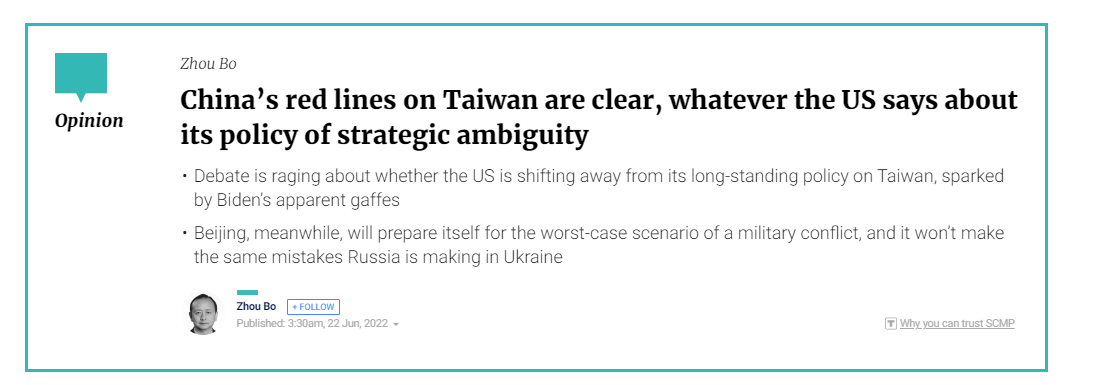
截圖來自南華早報
如果拜登一心要避免與俄羅斯發生直接衝突,那他為什麼執着於挑起與中國的潛在戰爭?中國人民解放軍是世界上規模最大的武裝力量,其實力並不遜於俄羅斯軍隊。
6月17日,中國人民解放軍海軍第三艘航空母艦下水,被命名為“福建艦”。這是一艘完全由中國自主設計建造的首艘彈射型航空母艦,配置飛機電磁彈射裝置。相比之下,俄羅斯唯一的航空母艦多年來一直處於維修狀態。中國人民解放軍海軍的艦艇數量也已經超過美國海軍的數量。
因此,如果真如拜登政府咬定的那樣,中國是一個比俄羅斯更嚴峻的長期威脅,那麼華盛頓難道不應該儘量避免與中國發生衝突嗎?畢竟,戰爭一旦發生,戰場距美國本土遙遠,美盟友寥寥無幾,但北京卻擁有一切“主場”優勢。
拜登政府表態不一的原因或許在於,莫斯科用核攻擊威脅北約,而北京承諾在任何情況下都不會首先使用核武器。
如果認為俄羅斯所擁有的世界最大核武庫在阻止美國干預(俄烏衝突)方面發揮了決定性作用,那麼北京可能會重新考慮其目前“精幹有效”的核武庫規模是否合理。從理論上講,不首先使用核武器的政策需要一個龐大的核武庫作為支撐,只有核武器多到能在敵人的第一次打擊中活下來,才有能力實施有效的報復性核打擊。
儘管拜登在東京“失言”後重申美國堅持“一箇中國”政策,但他在九個月內的三次明顯“失言”,似乎預示着美國正在從幾十年來對台政策的“戰略模糊”轉變為“戰略清晰”。
拜登對於有關台灣防務問題的一再“失言”並不是鬧着玩的。
支持“戰略模糊”的人認為,該政策既可以威懾中國,同時又防止台獨。然而,支持“戰略清晰”的人則認為,模糊性的政策已不足以讓中國大陸放棄對台灣使用武力的選項。
中國統一台灣的決心不變,而且解放軍也派軍機在台海巡航以示警告,但沒有跡象表明大陸因為俄烏衝突而在加速統一台灣進程。
中國宣佈2022年國防預算的時間,是在俄烏衝突爆發之後。預算總額被控制在GDP的2%以內,這與近些年的情況一致。這充分體現了中國對安全環境現狀的評估,以及對最終統一台灣的信心。
根據中國《反分裂國家法》,中國只有在三種情況下才會採取非和平方式統一台灣:“台獨”分裂勢力以任何名義、任何方式造成台灣從中國分裂出去的事實,或發生將會導致台灣從中國分裂出去的重大事變,或和平統一的可能性完全喪失。
台灣當局宣佈獨立的可能性幾乎為零,因為這肯定會引發大陸的軍事回應。但在北京的眼中,華盛頓從未停止製造“事變”以阻撓中國實現和平統一。
近年來,五角大樓派出了更多的軍艦過航台灣海峽,自2020年開始就已有30艘之多。去年,據《華爾街日報》報道,一支美國特種作戰部隊和一支海軍陸戰隊特遣隊一直在台灣秘密訓練台軍人員。
北京有充分理由懷疑華盛頓只是在口頭上履行其“一箇中國”的承諾。如果中美競爭如拜登所言是“極限的”,如美國國務卿布林肯所言“中國是世界上唯一一個有軍事、經濟、外交能力來削弱或挑戰這些基於規則的秩序的國家”,美國不正好將台灣用作其印太戰略大棋盤上一個馬前卒?
俄烏衝突為中國人民解放軍提供了可借鑑的經驗。俄軍最大的錯誤是一開始輕敵,在其對多條戰線同時發起的進攻中暴露明顯,而且人員不足、後勤補給遲滯,指揮鏈不暢。
解放軍不可能犯這樣的錯誤。美國的《與台灣關係法》並沒有明確規定美國軍隊有義務協防颱灣,但可以肯定的是,解放軍將為美軍和美國盟友的干預做好戰鬥準備。
換言之,無論美國的對台政策“戰略模糊”還是“戰略清晰”,都不會阻礙解放軍的軍事準備。在近日的香格里拉對話會中,中國國務委員兼國防部長魏鳳和明確強調,如果有人膽敢把台灣分裂出去,解放軍必將 “不惜一戰”。
台灣問題是中國的核心利益之一。這意味着中國人民解放軍決不會在主權之戰中失敗。一旦戰爭開始,像俄烏衝突中的僵局極不可能出現,停火談判更是絕無可能。
拜登喜歡引用他父親的話説,比有意挑起的衝突更糟糕的,只能是無意間引發的衝突。問題在於,在台灣海峽,如果發生衝突,都不會是無意為之的。
翻譯:蔣紹澄
核譯:許馨勻 韓樺
China’s red lines on Taiwan are clear, whatever the US says about its policy of strategic ambiguity
Will the United States come to defend Taiwan militarily in a war across the Taiwan Strait? This million-dollar question so far has two answers from the same administration – yes, according to US President Joe Biden when he was asked in Tokyo in late May; not necessarily, according to White House aides who quickly walked back his comment and said America’s “one China” policy had not changed.
This question becomes all the more interesting if one compares Biden’s attitudes towards Moscow and Beijing. Ever since the beginning of the war in Ukraine, Biden has consistently said US troops would not directly engage in this conflict.
If Biden is determined to avoid direct conflict with Russia, why is he so adamant to provoke a potential war with China? The People’s Liberation Army, the largest armed forces in the world, would not be less formidable than the Russian military.
The PLA Navy has three aircraft carriers – compared with Russia’s only aircraft carrier that has been undergoing repairs for years – and even more ships than the US navy. On June 17, China unveiled its third aircraft carrier, the Fujian, a locally designed carrier equipped with an electromagnetic catapult for launching aircraft.
So, if indeed China is a greater long-term threat than Russia, as the Biden administration has concluded, shouldn’t Washington try to avoid a conflict with China, especially as it would be fought in a faraway battlefield where the US has fewer allies while Beijing has all the advantages of fighting on home turf?
Perhaps the reason is, unlike Moscow that has threatened NATO with nuclear attacks, Beijing vows it would never be the first to use nuclear weapons in any circumstances.
If Russia’s nuclear stockpile – the world’s largest – had played a decisive role in deterring US involvement, Beijing might have to reconsider its “small and effective” nuclear arsenal. Theoretically, a no-first-use policy requires a large nuclear arsenal to enable an effective retaliatory second strike after surviving the enemy’s first strike.
In spite of Biden’s reiteration afterwards of US adherence to the “one China” policy, his apparent gaffe – the third in nine months – would seem to signal a bourgeoning US policy of “strategic clarity”, a shift from its decades-old policy of “strategic ambiguity”.
Biden’s Taiwan defence ‘gaffes’ are no laughing matter.
Supporters of strategic ambiguity believe such a policy would deter China while not emboldening those in Taiwan who favour independence. Supporters of strategic clarity, however, argue that such vagueness is already inadequate to deter a possible attack by mainland China.
Notwithstanding China’s determination for reunification and the PLA sending its aircraft flying near Taiwan as a warning, there is no indication the mainland is accelerating its plan to take over Taiwan because of the war in Ukraine.
China’s 2022 defence budget, announced after the eruption of the conflict, was kept within 2 per cent of its GDP, as it has been in recent years. It speaks volumes of China’s assessment of the security environment and its confidence about eventual reunification with Taiwan.
According to China’s anti-secession law, China would only resort to non-peaceful means in its attempt to reunify with the island under three circumstances: Taiwan has declared independence; a major incident has occurred leading to Taiwan’s secession from China; or if all the possible avenues for a peaceful reunification have been completely exhausted.
The probability of the Taiwanese authorities declaring independence is next to impossible, since it would most certainly invite a military response from across the strait. But in Beijing’s eyes, Washington has never ceased in creating “incidents” to impede the mainland’s efforts for a peaceful unification.
The Pentagon has sent more warships sailing through the Taiwan Strait in recent years – 30 since the start of 2020. Last year, The Wall Street Journal reported that a US special-operations unit and a contingent of marines have been secretly operating in Taiwan to train military forces there.
Beijing has good reason to suspect Washington is only paying lip service to its “one China” pledge. If the competition between China and the US is to be “extreme”, as Biden described, and if indeed China is “the only country with both the intent to reshape the international order and, increasingly, the economic, diplomatic, military, and technological power to do it”, as Secretary of State Antony Blinken asserted, won’t the US make use of Taiwan as a convenient pawn in the grand chessboard of the Indo-Pacific?
The conflict in Ukraine provides lessons to learn for the PLA. The Russian military’s biggest error was underestimating its enemy in the beginning. This was clear in its attacks on multiple fronts without adequate troops, sufficient supplies and logistics support, and a clear line of command.
Such mistakes are unlikely to be made by the PLA. The Taiwan Relations Act does not explicitly oblige American forces to come to the island’s defence. But you can be sure the PLA would be prepared for such a fight, involving not just American troops but all its allies in the region.
In other words, neither America’s strategic ambiguity or strategic clarity could hold back PLA’s military buildup. At the recent Shangri-La Dialogue, Chinese defence minister Wei Fenghe vowed to “fight to the very end” to stop a Taiwanese secession.
The Taiwan issue is one of China’s core interests. That means the PLA cannot afford to lose in a war fighting for China’s sovereignty. Once a war starts, a stalemate as we are seeing in Ukraine is highly unlikely, and a ceasefire would be out of the question.
Biden likes to quote his father in saying the only conflict worse than an intended one is an unintended one. The problem is, in the Taiwan Strait, there won’t be any unintended conflicts.
【原文鏈接:https://www.scmp.com/comment/opinion/article/3182379/chinas-red-lines-taiwan-are-clear-whatever-us-says-about-its-policy】
本文系觀察者網獨家稿件,文章內容純屬作者個人觀點,不代表平台觀點,未經授權,不得轉載,否則將追究法律責任。關注觀察者網微信guanchacn,每日閲讀趣味文章。