美國環保署關於氯乙烯危害的概述_風聞
灵丹妙药-02-15 17:09
最近美國發生因為火車出軌引發的氯乙烯泄漏,媒體上關於氯乙烯危害性有些爭論。我找了一下。美國環保署在前些年就發佈過相關文件。這些文件發佈時間遠早於這次事故,感覺不應該有隱瞞。
氯乙烯是一個生產了很多年的物質,對其危害和毒性瞭解也比較深入。例如美國環保署發佈的“TOXICOLOGICAL REVIEW OF VINYL CHLORIDE氯乙烯的毒理學研究進展”發佈於2000年5月,但太長了,有197頁。我找到了較短的一個,發佈於2020年3月的一篇概述。這個文件只有6頁。我試着翻譯了一下。如果有錯誤,請大家指正。
按照EPA文件描述,氯乙烯是有甜味的,以前講美國空氣香甜的那位是不是吸了氯乙烯,自己還不知道。如果真是這樣,趕緊去體檢。
上述文件的鏈接如下,有興趣的朋友可以自己下載閲讀。
TOXICOLOGICAL REVIEW OF VINYL CHLORIDE Simple Search | NSCEP | US EPA https://nepis.epa.gov/Exe/ZyNET.EXE?ZyActionL=Register&User=anonymous&Password=anonymous&Client=EPA&Init=1
Vinyl Chloride March 26 2020 https://www.epa.gov/sites/default/files/2020-05/documents/vinyl_chloride_march_26_2020.pdf
Vinyl Chloride****氯乙烯
75-01-4
__________________________________________________________________
Hazard Summary****危害總結
Most vinyl chloride is used to make polyvinyl chloride (PVC) plastic and vinyl products. Acute (short-term) exposure to high levels of vinyl chloride in air has resulted in central nervous system (CNS) effects, such as dizziness, drowsiness, and headaches in humans. Chronic (long-term) exposure to vinyl chloride through inhalation and oral exposure in humans has resulted in CNS effects and liver damage. Animal studies have reported effects on the liver, kidney, and CNS from chronic exposure to vinyl chloride. Vinyl chloride exposure, via inhalation, has been shown to increase the risk of a rare form of liver cancer, angiosarcoma of the liver, in humans. EPA has concluded that vinyl chloride is carcinogenic to humans by the inhalation and oral routes of exposure, and highly likely to be carcinogenic by the dermal route of exposure.
大多數氯乙烯被用於製造聚氯乙烯(聚氯乙烯)塑料和乙烯基產品。急性(短期)暴露於空氣中高水平的氯乙烯會導致中樞神經系統(CNS)的影響,如人類的頭暈、嗜睡和頭痛。人類通過吸入和口服接觸長期(長期)接觸氯乙烯已導致中樞神經系統影響和肝臟損傷。動物研究已經報道了長期接觸氯乙烯對肝臟、腎臟和中樞神經系統的影響。通過吸入接觸氯乙烯,已被證明會增加人類患一種罕見的肝癌——肝血管肉瘤的風險。美國環境保護署得出的結論是,氯乙烯通過吸入和口服接觸途徑對人體致癌,而通過皮膚接觸途徑很有可能對人體致癌。
__________________________________________________________________
Please Note: The main sources of information for this fact sheet are the U.S. Environmental Protection Agency’s (EPA’s) Integrated Risk Information System and the Agency for Toxic Substances and Disease Registry’s (ATSDR’s) Toxicological Profile for Vinyl Chloride. (1,2)
請注意:本簡報的主要信息來源是美國環境保護署(EPA)的綜合風險信息系統和有毒物質和疾病登記處(ATSDR)的氯乙烯毒物學概況。(1,2)
Uses用途
• Most of the vinyl chloride produced is used to make polyvinyl chloride (PVC), a material widely used in automotive parts, packaging products, pipes, construction materials, furniture, and a variety of other products. (2)
大多數生產的氯乙烯被用於製造聚氯乙烯(聚氯乙烯),這是一種廣泛用於汽車零部件、包裝產品、管道、建築材料、傢俱和其他各種產品的材料。(2)
• Smaller amounts of vinyl chloride are used as a chemical intermediate and a solvent. (2,4)
少量的氯乙烯被用作化學中間體和溶劑。(2,4)
Sources and Potential Exposure****來源和潛在暴露
• Ambient air concentrations of vinyl chloride are generally quite low, with exposure occurring from the discharge of exhaust gases from factories that manufacture or process vinyl chloride, or evaporation from areas where chemical wastes are stored. (2,3)
環境空氣中氯乙烯的濃度通常都很低,暴露於從製造或加工氯乙烯的工廠排放的廢氣,或從化學廢物儲存的地區蒸發。(2,3)
• Vinyl chloride may enter finished drinking water from the flow of water through older PVC piping made before 1977, but a more recent study suggests that the extraction of vinyl chloride may diminish over time. Since 1977, product standards (NSF/ANSI 14 and
61) have controlled the release of vinyl chloride from PVC pipes. (5,6)
氯乙烯可能通過1977年以前製造的較舊的聚氯乙烯管道進入成品飲用水,但最近的一項研究表明,氯乙烯的提取可能會隨着時間的推移而減少。自1977年起,產品標準(NSF/ANSI 14和61)已經控制了從聚氯乙烯管道中產生的氯乙烯的釋放。(5,6)
• Occupational exposure to vinyl chloride may occur in those workers concerned with the production, use, transport, storage, and disposal of the chemical. (2,3)
與該化學品的生產、使用、運輸、儲存和處置有關的工人可能會職業性接觸氯乙烯。
• Vinyl chloride has been detected in tobacco smoke. (2)
已在煙草煙霧中已檢測到氯乙烯。(2)
Assessing Personal Exposure****評估個人接觸
• Vinyl chloride can be measured in urine, body tissue, and exhaled air but the tests are not reliable indicators of total exposure. (2)
氯乙烯可以在尿液、身體組織和呼出的空氣中測量,但這些測試不是總暴露的可靠指標。(2)
Health Hazard Information****健康危害信息
Acute Effects*:*急性影響
• Acute exposure of humans to high levels of vinyl chloride via inhalation has resulted in effects on the CNS, such as dizziness, drowsiness, headaches, and giddiness. (2,3)
人類通過吸入急性接觸高水平的氯乙烯會對中樞神經系統產生影響,如頭暈、嗜睡、頭痛和頭暈。(2,3)
• Acute exposure to high levels of vinyl chloride in animals has resulted in effects on the CNS, liver, kidney, and lungs. (2)
動物急性暴露於高水平的氯乙烯會對中樞神經系統、肝臟、腎臟和肺產生影響。(2)
• Tests involving acute exposure of mice have shown vinyl chloride to have high acute toxicity from inhalation exposure. (2,3)
涉及小鼠急性暴露的試驗表明,氯乙烯吸入暴露具有很高的急性毒性。(2,3)
Rules & Implementation
Chronic Effects *(Noncancer):*慢性影響(非癌症)
• Liver damage may result in humans from chronic exposure to vinyl chloride through both inhalation and oral exposure. (2,3)
人類長期通過吸入和口服接觸氯乙烯可能導致肝損傷。(2,3)
• A small percentage of individuals occupationally exposed to high levels of vinyl chloride in air have developed a set of symptoms termed “vinyl chloride disease,” which is characterized by Raynaud’s phenomenon (fingers blanch and numbness and discomfort are experienced upon exposure to the cold), changes in the bones at the end of the fingers, joint and muscle pain, and scleroderma-like skin changes (thickening of the skin, decreased elasticity, and slight edema). (2,3)
一小部分人職業暴露於高水平的氯乙烯空氣發展一系列症狀稱為“氯乙烯病”,其特點是雷諾現象(手指在寒冷的環境中會出現發白、麻木和不適),手指末端骨骼變化,關節和肌肉疼痛,和硬皮病樣的皮膚變化(皮膚增厚、彈性下降和輕微水腫)。(2,3)
• CNS effects (including dizziness, drowsiness, fatigue, headache, visual and/or hearing disturbances, memory loss, and sleep disturbances) as well as peripheral nervous system symptoms (peripheral neuropathy, tingling, numbness, weakness, and pain in fingers) have also been reported in workers exposed to vinyl chloride. (2)
中樞神經系統效應(包括頭暈、嗜睡、疲勞、頭痛、視覺和/或聽力障礙、記憶喪失和睡眠障礙)以及周圍神經系統症狀(周圍神經病變、刺痛、麻木、虛弱、手指疼痛)在接觸氯乙烯的工人中也有報道。(2)
• Animal studies have reported effects on the liver, kidney, and CNS from chronic exposure to vinyl chloride. (2,3)
動物研究已經報道了長期接觸氯乙烯對肝臟、腎臟和中樞神經系統的影響。(2,3)
• EPA has established a Reference Concentration (RfC) of 0.1 milligrams per cubic meter (0.1 mg/m3 ) based on effects on the liver in rats. The RfC is an estimate (with uncertainty spanning perhaps an order of magnitude) of a continuous inhalation to the human population (including sensitive subgroups) that is likely to be without
appreciable risk of deleterious noncancer effects during a lifetime. It is not an estimator of risk but rather a reference point to gauge the potential for effects. At exposures increasingly greater than the RfC, the potential for adverse health effects increases.
Lifetime exposure above the RfC does not imply that an adverse effect would necessarily occur. (1)
EPA已確定參考濃度(RfC)為0.1毫克/立方米(0.1毫克/米3),基於對大鼠肝臟的影響。RfC是對人類人口(包括敏感亞組)持續吸入的估計(不確定性可能跨越一個數量級)。在一生中產生有害的非癌症影響的明顯風險。它不是風險的估計量,而是衡量潛在影響的參考點。當暴露量越來越大於RfC時,對健康的不利影響可能會增加。暴露在RfC以上的壽命並不意味着一定會發生不良影響。(1)
• EPA has established a Reference Dose (RfD) for vinyl chloride is 0.003 milligrams per kilogram body weight per day (mg/kg/d) based on liver toxicity in rats. (1)
EPA已經根據大鼠的肝臟毒性確定了氯乙烯的參考劑量(RfD)為每天0.003毫克/公斤體重(mg/kg/d)。(1)
• , Tribal
Resources
Reproductive*/*Developmental Effects :生殖/發育效應
• Several epidemiological studies have reported an association between vinyl chloride exposure in pregnant women and an increased incidence of birth defects; however, other studies have not supported these findings. (2,3)
幾項流行病學研究報告了孕婦接觸氯乙烯與出生缺陷發生率增加之間的聯繫;然而,其他研究並沒有支持這些發現。(2,3)
• Several case reports involving worker exposures suggest that male sexual performance may be affected by vinyl chloride; however, these reports are limited by possible co- exposure to other chemicals and lack of exposure estimates. (2)
一些涉及工人接觸的案例報告表明,男性的性行為可能受到氯乙烯的影響;然而,這些報告由於可能共同接觸其他化學品和缺乏暴露估計而受到限制。(2)
• Testicular damage and decreased male fertility have been reported in rats exposed to vinyl chloride. (2)
有報道稱,暴露於氯乙烯的大鼠的睾丸損傷和雄性生育能力下降。(2)
• Animal studies have reported decreased fetal weight and birth defects in the offspring of rats exposed to vinyl chloride through inhalation at levels that are also toxic to maternal animals. (2)
動物研究報告稱,通過吸入氯乙烯暴露的大鼠後代的胎兒體重下降和出生缺陷,其水平對母體動物也有毒性。(2)
Cancer Risk*:*癌症風險
• Inhaled vinyl chloride has been shown to increase the risk of a rare form of liver cancer (angiosarcoma of the liver) in humans. (1,2,3)
吸入氯乙烯已被證明會增加人類患一種罕見的肝癌(肝血管肉瘤)的風險。(1,2,3)
• Animal studies have shown that vinyl chloride, via inhalation, increases the incidence of angiosarcoma of the liver and cancer of the liver. (1,2,3)
動物研究表明,通過吸入氯乙烯,會增加肝臟血管肉瘤和肝癌的發病率。(1,2,3)
• Several rat studies show a pronounced early-life susceptibility to the carcinogenic effect of vinyl chloride, i.e., early exposures are associated with higher liver cancer incidence than similar or much longer exposures that occur after maturity. (2)
一些大鼠研究表明,早期對氯乙烯的致癌作用。例如,與成熟後類似或更長時間的暴露相比,早期暴露與更高的肝癌發病率相關。(2)
• EPA has classified vinyl chloride as a known human carcinogen by the inhalation route of exposure. (1)
美國環境保護署已通過吸入接觸途徑將氯乙烯歸類為已知的人類致癌物。(1)
• EPA uses mathematical models, based on animal studies, to estimate the probability of a person developing cancer from breathing air containing a specified concentration of a chemical. EPA has calculated inhalation unit risk estimates of 4.4 x 10⁻⁶ (µg/m3 )- 1 for exposure to vinyl chloride during adulthood and 8.8 × 10⁻⁶ (µg/m3 )- 1 for lifetime exposure. EPA estimates that, if an individual were to continuously breathe air containing vinyl chloride at an average of 0.11 ug/m3 (1.1 x 10⁻⁴ mg/m3 ) over his or her entire lifetime, that person would theoretically have no more than a one-in-a-million increased chance of developing cancer as a direct result of breathing air containing this chemical. Similarly, EPA estimates that continuously breathing air containing 1.1 µg/m3 (1.1 x 10⁻³ mg/m3 ) would result in not greater than a one-in-a-hundred thousand increased chance of developing cancer, and air containing 11 µg/m3 (1.1 x 10⁻² mg/m3 ) would result in not greater than a one-in-ten thousand increased chance of developing cancer. For a detailed discussion of confidence in the potency estimates, please see IRIS.(1)
美國環境保護署使用基於動物研究的數學模型,來估計一個人因呼吸含有特定濃度的化學物質的空氣而患癌症的概率。環保署計算出在成年期接觸吸入氯乙烯單位風險估計為4.4×10⁻⁶(µg/m3)-1和終身暴露為8.8×10-6(µg/m3)-1。環保署估計,如果一個人在他或她的一生中持續呼吸含有平均0.11ug/m3的空氣(1.1×10-4mg/m3),理論上,由於呼吸含有這種化學物質的空氣,他患癌症的幾率不會超過百萬分之一。同樣,EPA估計,持續呼吸含有1.1µg/m3的空氣(1.1×10-3mg/m3)將導致患癌症的幾率增加不超過十萬分之一,以及含有11µg/m的空氣3(1.1×10-2mg/m3)將導致患癌症的幾率增加十萬分之一。有關對效價估計的信心的詳細討論,請參閲IRIS。(1)
• EPA has calculated an oral cancer slope factor of 7.2 x 10- 1 (mg/kg-day) for oral exposure to vinyl chloride during adulthood and an oral cancer slope factor of 1.4 (mg/kg-day) for lifetime exposure. (1)
EPA計算出成年期口腔氯乙烯暴露的口腔癌斜率為7.2×10⁻¹(mg/kg-天),終生暴露的口腔癌斜率為1.4(mg/kg-天)。(1)
Physical Properties****物理性質
• Vinyl chloride is a colorless, flammable gas with a mild, sweet odor. (4)
氯乙烯是一種無色、可燃的氣體,具有温和、有甜味的氣味。(4)
• The odor threshold for vinyl chloride ranges from 260 ppm to 4,000 ppm. (4)
氯乙烯的氣味閾值範圍為260 ppm至4,000 ppm。(4)
• The chemical formula for vinyl chloride is C2H3Cl and the molecular weight is 62.5 g/mol.
(4)
氯乙烯的化學式為C2H3Cl,其分子量為62.5g/mol。(4)
• The vapor pressure for vinyl chloride is 2,600 mm Hg at 25 °C, and it has a log octanol/water partition coefficient (log Kow ) of 1.36. (2)
在25℃下,氯乙烯的蒸汽壓為2600mmHg,它的log辛醇/水的分配係數(log Kow)為1.36。(2)
Conversion Factors:轉換因子
To convert concentrations in air (at 25 °C) from ppm to mg/m3*:* mg*/m3* = (ppm) × (molecular weight of the compound)/(24.45). For vinyl chloride*:* 1 ppm = 2.6 mg*/m3**.*
將空氣中的濃度(在25*℃下)從ppm轉化為mg/m3**: mg/m3=(ppm)×(化合物的分子量)/(24.45)。對於氯乙烯: 1 ppm = 2.6 mg/m3**.*
Health Data from Inhalation Exposure
吸入性暴露產生的健康數據
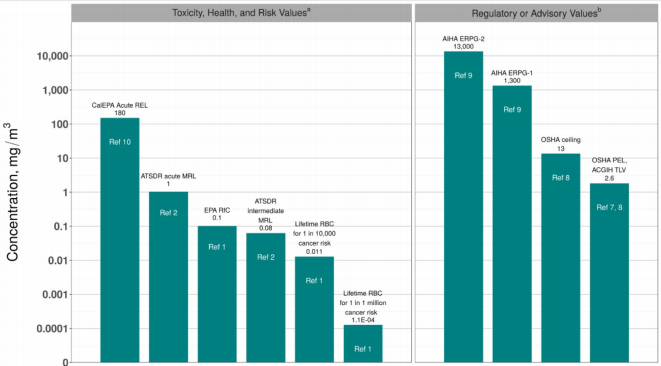
ACGIH TLV--American Conference of Governmental and Industrial Hygienists’ threshold limit value expressed as a time-weighted average; the concentration of a substance to which most workers can be exposed without adverse effects.
美國政府和工業衞生師會議的閾值以時間加權平均值表示;大多數工人可以接觸而沒有不良影響的物質的濃度。
AIHA ERPG - American Industrial Hygiene Association’s emergency response planning guidelines. ERPG 1 is the maximum airborne concentration below which it is believed nearly all individuals could be exposed up to one hour without experiencing other than mild transient adverse health effects or perceiving a clearly defined objectionable odor; ERPG 2 is the maximum airborne concentration below which it is believed nearly all individuals could be exposed up to one hour without experiencing or developing irreversible or other serious health effects that could impair their abilities to take protective action.
美國工業衞生協會的應急響應規劃指南。ERPG 1是空氣中的最大濃度,據信低於該濃度,幾乎所有人都可能暴露在空氣中長達一小時,而不會出現輕微的短暫不良健康影響或明顯的不良氣味;ERPG 2是空氣中的最大濃度,據信低於該濃度,幾乎所有人都可能暴露在空氣中長達一小時,而不會經歷或發展出不可逆或其他嚴重的健康影響,從而損害其採取保護措施的能力。
ATSDR MRL – An inhalation MRL is an estimate of the amount of a chemical a person can breathe each day without a detectable risk to health. MRLs are developed for health effects other than cancer. MRLs can be calculated for 3 different time periods of exposure to the chemical: acute (about 1 to 14 days), intermediate (from 15-364 days), and chronic (exposure for more than 364 days).
吸入MRL是一個人每天可以吸入而不會對健康造成可檢測的風險的化學品量的估計值。MRL是為除癌症以外的健康影響而開發的。MRLs可以計算3個不同的化學品暴露時間段的最大殘留限量:急性(約1至14天)、中等(15-364天)和慢性(暴露超過364天)。
CalEPA Acute REL – California EPA Office of Environmental and Human Health Assessment (OEHHA) acute reference exposure level is the concentration at or below which no adverse health effects are anticipated for a specified exposure duration.
加利福尼亞州環境和人類健康評估辦公室(OEHHA)急性參考暴露水平是指在規定的暴露持續時間內,預期不會對健康產生不良影響的濃度。
OSHA PEL--Occupational Safety and Health Administration’s permissible exposure limit expressed as a time-weighted average: the concentration of a substance to which most workers can be exposed without adverse effect averaged over a normal 8-h workday or a 40-h workweek.
職業安全與健康管理局的允許接觸限值表示為時間加權平均值:大多數工人在正常8小時工作日或每週40小時工作內可以暴露而不會產生不良影響的物質的濃度。
OSHA PEL Ceiling -- Occupational Safety and Health Administration’s permissible exposure limit expressed as a short-term exposure limit that should not be exceeded in a 15-minute time period.
職業安全與健康管理局的允許接觸限值表示為15分鐘內不得超過的短期接觸限值。
RBC — Risk-based concentration.
基於風險的濃度
a Toxicity, Health, and Risk numbers are toxicological values from animal testing or risk
assessment values developed by EPA.
毒性、健康和風險值是EPA制定的動物試驗或風險評估值的毒理學值。
b Regulatory numbers are values that have been incorporated in Government regulations, while advisory numbers are nonregulatory values provided by the Government or other groups as advice. OSHA numbers are regulatory, whereas ACGIH, NIOSH, and AIHA numbers are advisory.
監管數值是已納入政府法規的數值,而諮詢數值是政府或其他團體提供的作為建議的監管數值。OSHA數值為監管類,而ACGIH、NIOSH和AIHA數值為諮詢類。
Summary updated in March 2020
摘要已於2020年3月更新
References****參考文獻
1. U.S. Environmental Protection Agency. Integrated Risk Information System (IRIS) on Vinyl chloride. National Center for Environmental Assessment, Office of Research and Development, Washington, DC. Last revised 8/07/2000.http://www.epa.gov/iris
2. Agency for Toxic Substances and Disease Registry (ATSDR). Toxicological Profile for Vinyl Chloride. Public Health Service, U.S. Department of Health and Human Services, Atlanta, GA. 2006.http://www.atsdr.cdc.gov/toxprofiles/tp20.pdf
3. U.S. Department of Health and Human Services. Hazardous Substances Data Bank (HSDB, online database). National Toxicology Information Program, National Library of Medicine.
2020.http://pubchem.ncbi.nlm.nih.gov/compound/6338
4. Pohanish, R.P. Sittig’s Handbook of Toxic and Hazardous Chemicals and Carcinogens. 6th ed. Elsevier Inc. Oxford, UK and Waltham, MA USA. 2012.
5. Flournoy, R. L., Monroe, D., Chestnut, N., & Kumar, V. (1999). Health effects from vinyl chloride monomer leaching from pre-1977 PVC pipe. In Annual American Water Works Association Conference Proceedings (pp. 1211-1230).
6. Walter, R. K., Lin, P. H., Edwards, M., & Richardson, R. E. (2011). Investigation of factors affecting the accumulation of vinyl chloride in polyvinyl chloride piping used in drinking water distribution systems. Water research, 45(8), 2607-2615.
7. American Conference of Governmental Industrial Hygienists (ACGIH). 2018 TLVs and BEIs. Threshold Limit Values for Chemical Substances and Physical Agents, Biological Exposure Indices. Cincinnati, OH. 2018.
8. Occupational Safety and Health Administration (OSHA). Occupational Safety and Health Standards, Toxic and Hazardous Substances. Code of Federal Regulations. 29 CFR 1910.1000. 2018.
https://www.osha.gov/pls/oshaweb/owadisp.show_unique?p_table_name=STANDARDS& p_unique_file=1910_1017&p_anchor_name=
9. American Industrial Hygiene Association (AIHA). The AIHA 2018 Emergency Response Planning Guidelines and Workplace Environmental Exposure Level Guides Handbook. 2018.
10. California Environmental Protection Agency (CalEPA). Technical Supporting Document for Noncancer RELs, Appendix D2. Office of Environmental Health Hazard Assessment. 2008.
https://oehha.ca.gov/chemicals/vinyl-chloride